
China: a journey through a fascinating past, a vibrant present and a runaway future.
.JPG/v1/fill/w_320,h_320/file.jpg)
Translation disclaimer: This page was translated using automated software for your convenience.No guarantee is given regarding the accuracy of the translation. The content will be manually reviewed later.
- Lost in transformation: a dazzling, mind-blowing, nerf shaking, perception boomeranging,
wondering load of 15 days information, impressions and experiences -
Day 1 and 2: from Brussels to Beijing
Introduction : I've traveled almost the entire world, but inland China, with the exception of Hong Kong, has remained "undiscovered" for me. China, a magical destination, isn't it? Tintin and the Blue Lotus, Chinese vases, those restaurants in red and gold during my childhood, Chinese lanterns, dragon motifs, and traditional artwork. Magical, isn't it?

For fifteen years, I've been developing plans for a compelling, customized super-discovery journey. I remember unintentionally stringing along a certain Chinese man, the delightful name of Wonder Wang, for three years while developing a personalized program. It never quite worked out; something else came up, or something was just a bit more interesting, and it wouldn't go away. Anyway.
Knack Reizen's offer: two days in Beijing, Xi'an, a Yangtze river cruise with the famous Three Gorges Dam, and two days in Shanghai—yes, that sounded like a good idea. Especially after a wonderful trip with Rivages on the Douro. And with former VRT China correspondent Stefan Blommaert as a lecturer. We're going for it.

Dear reader, the actual travel report is supplemented with "background information" about China today and its historical background.
This additional information and explanation is always in italics . Readers in a hurry can skip this. This travelogue is going to be a long journey.
Disclaimer : The (general) information I provide or describe is based on what the guides told us. Or at least, as I believe I understood it. I also deliberately use Chinese and English terms, expressions, and names, or their translations, interchangeably. In my opinion, this enhances the experience with a certain "local color." All photos are my own; only three were taken from the internet and added for clarification (such as aerial shots).
We fly to Beijing with Qatar Airways in the afternoon. Around midnight, we have two and a half hours for a transfer in Doha. Amidst the maze of escalators and the many floors, we arrive at a zone that consists of a complete indoor tropical park, with huts and places where you can even lie down or curl up, and with all sorts of food, drink, rest areas, and other amenities. Wonderful.

In Beijing, we undergo a rigorous security check. So thorough it's almost physical. They swipe their detectors in and around every part of my body. I even have to empty my wallet, and they check every compartment. Immigration control is also quite serious.
Tour guide Karin is singled out by customs. They take a book about China from her luggage. A map inside shows Taiwan in a different color than China (meaning it's not part of mainland China). Ouch. They want to open her book. Karin compromises by tearing out the offending page. That's what you call a "getaway."

In the arrivals hall, soldiers in green and khaki uniforms with white gloves parade in a straight goose-step, or sit motionless somewhere, just… observing, I suppose. My wife, Nella, wants to take pictures right away—she's not allowed to—but she does so secretly. Every piece of our group's luggage is stacked and taken straight to the hotel room. We then board the bus to the Park Plaza Beijing Hotel , near the important Wangfujing shopping street . A quick dinner follows, and then we go to bed to work off the seven-hour time difference.
Day 3: Beijing: The Sacred Way, the Ming Tombs, the Chinese Wall, the Summer Palace .
Short introduction : Beijing is the political and cultural capital of China. Xi'an is also historical and cultural. Shanghai: the economic capital .
“Nihao!” (Hello). Beijing means northern capital. We drive out of this magnificent city (population 21.5 million), consisting of modern buildings and shops that are "albeit Chinese-style"

They can compete with our cities. Slightly more unique are the more primitive Hutongs: poorer neighborhoods where a kind of community lives together, sharing facilities, such as outdoor toilets. Incidentally, in winter it sometimes gets -15 degrees Celsius here.
Is there anything they share with us, you ask? Yes, traffic jams! Apparently, everyone here spends an average of three hours a day stuck in traffic. There is, however, extensive public transport. Metros, buses, taxis, and countless small, yellow and light-blue shared bicycles with ridiculously low seats and… no lights. They're teeming with them. But they're convenient! You simply rent them using a QR code.
First, some important explanations.
Payment. The QR code has been the main payment method here for years. Even those bicycles: scan the QR code and you have it
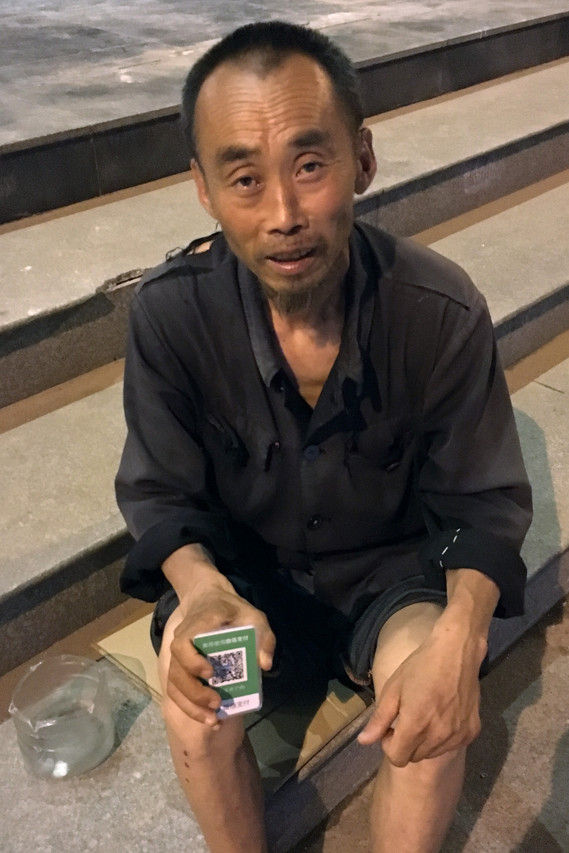
Behind wherever you want. Even a (rare) beggar here has his own QR code. Alipay proves to be the most convenient for us – their Bancontact. That does require some fiddling (Chinese characters!). Striking: the delivery system here is incredibly strict. Hence those dangerous scooters everywhere; they have to deliver on time, otherwise they lose points (fines), so they take risks. Online e-commerce is booming here even more than in our country. Much more so, in fact. Although there's no shortage of shops, including those with top luxury items . According to our guide, Lynn, window shopping is more the thing. The currency is CNY: renminbi (official name) or yuan (popular name). Through Alipay, the Ali Baba group, also with its e-commerce, has a firm grip on the national economy. 1 euro = 8.03 yuan.
About cars: The booming electric car industry already supplies 30% of the national vehicle fleet. These cars are being promoted and are available immediately. Charging stations are available almost everywhere. Gasoline cars, on the other hand, are on a waiting list, which can take years, and are only available through a lottery system. Most electric cars (with different license plates, by the way) are Chinese-made, although I did spot a few Teslas. And there are also self-driving cars...
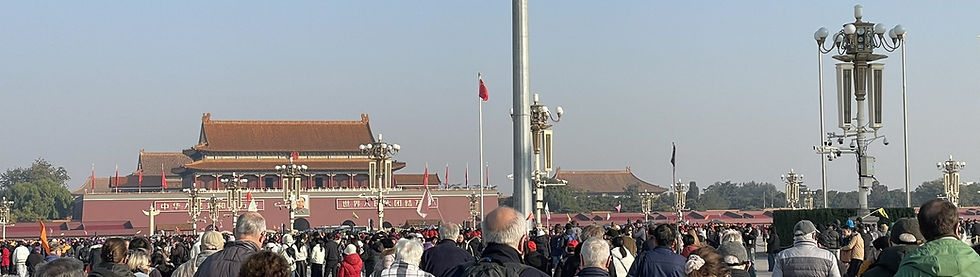
Regarding public cameras, the most striking and impressive feature is the ubiquitous CCTV cameras. Reportedly, there's even one camera for every two or three Chinese residents. Indeed, an invasion of privacy, with fines now even being applied to violations via a point system. This latter project is still in development. The effect is a very low (though still small) crime rate.
Air pollution. Apparently positive: decades ago, Beijing had a huge smog problem, with face masks everywhere. Since then, it's apparently improved thanks to interventions. (On the DS e-news site of November 6, 2025, I read that China wants to be a leader in the Green Deal.) Well, look at that.
Toilets. This part of everyone's daily life, so different elsewhere. What we call "French toilets"

Calling it a hole in the ground—not a pot, but a hole in the ground—is a real ordeal for us. It's the reality in China. But in most tourist spots, you have the same layout: squat toilets and flush toilets. I hate squatting, besides the fear of falling and no support anywhere—what's wrong with a few handrails? Anyway, do you have that too? Now I understand their passion for martial arts; it all started with… Tip: always carry toilet paper/tissues. China clearly saves money. Everywhere.
We'll pass the famous and beautiful Bird's Nest Olympic Stadium (2008) and then continue north, where we'll admire and fully explore the Sacred Way (Lin's pronunciation sounds like "secret way") of the Ming Dynasty, built between 1368 and 1644 (later followed by the Qing Dynasty). This will be followed by an exploration of the Imperial Necropolis.

About emperors, concubines and eunuchs.
Note : All information so far is the story as I recorded it and understood it from guide Lin's Chinese-sounding English.
Each emperor had an empress, along with up to hundreds of concubines of varying rank. The lowest rank were the ladies in waiting. These young girls, chosen from noble families, had a miserable life. Except for a possible night with the emperor, they remained locked within the palace with its 9,999 rooms spread across 72 hectares, waiting to die. Unlike the emperors, who sometimes died young—around twenty. You might wonder: fucked to death?

The male servants, numbering up to fifty, were eunuchs. Serving and approaching the emperor always had to be done naked, for fear that weapons might be hidden under clothing for a possible attack. The fear of assassination dominated every emperor's life. For example, tall trees were not allowed next to the palace walls (danger of arrows). And every evening, 27 bedrooms were available (with shoes at the wrong door), so it was unclear where the emperor actually spent the night. In short, the man lived in constant fear. Incomprehensible. After all, you want to be loved by your people, don't you?
Ultimately, the Qing dynasty's empire died out due to the lack of heirs. This is beautifully depicted in Bernardo Bertolucci's famous film "The Last Emperor." The last and youngest emperor was just two years and nine months old...
Every three years the emperor selected new concubines between thirteen and sixteen years old.

For the noble families, it was an honor, and it brought in money. For the girls, however… It was difficult for the emperor to remember all those names, so they had to do their utmost to be remembered. The choice of night was based on their nakedness. No weapons, you know. Eunuchs would then wait outside the room. About the time it takes to burn an incense stick—45 minutes. Then the eunuch would knock a maximum of two times. They also kept track of who he spent each night with, in order to avoid any pregnancies. The imperial doctor would then feel her pulse to see how many months old she was.

It was a time of intrigue and horror. For instance, an empress was once pregnant with a daughter by a guard, and he and the child were burned alive in an oven. Out of her sadness, that empress turned to opium. Know that all those other women were, of course, rivals and enemies. In the early years of the dynasty, many died a life of waiting and loneliness, often by suicide, usually by hanging.
We reach the region of the imperial tombs, some of which (three out of thirteen) are still undiscovered. Only the emperor and empress were buried in these tombs. Each had their own palace; the concubines had their own room in another palace, while the lowest-ranking members had to live together. Around the city were villages where the guardians of the tombs (full of treasures) lived, surrounded by the protective Tiger and Dragon Mountains (80 km²) .
Lynn promises to tell us the story of the Dragon Lady and the robbed graves. It's a long and intriguing story , but I won't rehash it here.

The Sacred Way is a mile-long walking path lined with statues of camels, elephants, lions, and especially guardians and dignitaries, leading to the Dragon and Phoenix Gate .
Then we drive to the most unique Ming Tomb, the Changling Mausoleum (UNESCO, 40 km², 15th century ) a little further on, designed according to the Chinese principles of feng shui . It has a Big Hall , supported by exceptionally sturdy wooden poles made from centuries-old mango trees, a strong and very exclusive wood.
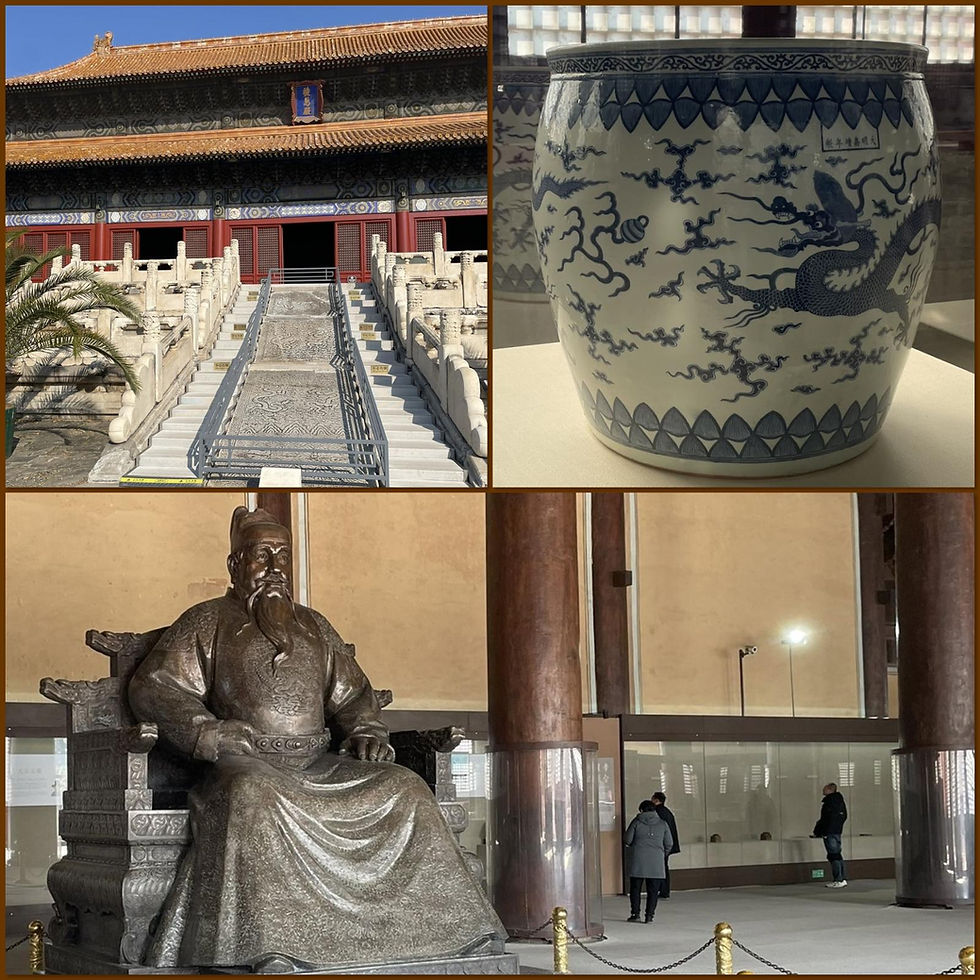
We see the large statue of Emperor Yongle , founder of the Forbidden City, number three in the Ming Dynasty. We also admire the clothes of the emperors and empresses of the time. I learn that the color yellow was reserved only for the emperor. For others, yellow was forbidden; moreover, wearing it meant you had ambition—that is, aspirations to become emperor.
We admire various other artefacts: vases, utensils, ship models, you name it.
There were thirteen Ming emperors. That first emperor, Qin Shi Huangdi, certainly had the enormous merit of transforming all those small kingdoms into one great empire, united by a single language, a single metric system, and multiple mutual agreements. But his obsession with death, hence his life's work building those tombs, cost the lives of some 70,000 men over 38 years. He was ultimately assassinated by farmers. They broke into the tombs to break the statues of the guards. All the then-collaborators were murdered. But the tomb itself was never found, because all the books about the work had been burned. The only one who knew where it was was murdered. You wanted a compelling story. You ask, and China tells the story.
*** See also the day after tomorrow: Terracotta Army.
Lunchtime. First, a jade shop . Jade mineral stones are very popular in this country, because

A symbol of good luck. Almost every Chinese person wears a shiny jade bracelet. We look at various objects made of jade, primarily green but also in other colors. We catch a glimpse of the grinding work, now performed mechanically. The four balls, loosely inside themselves and with holes, called the Happy Family , are particularly unusual.
Then (naturally) comes the sales moment in a huge hall with dozens of "willing Chinese." Only after we've made it through do we end up in a dining room where the familiar Chinese system of a central, rotating shelf full of dishes is offered at round tables.
What a concept! First, you shop and then... you get to eat.

I use my image translation app, which tells me that the characters on the Chinese beer bottles mean "Snowflake" and that it contains a mere 2.9 degrees of alcohol. Table beer, then. Unfortunately, one saucer sticks out a bit too far. When I turn it, it bumps into my glass, resulting in wet pants.
And… of course, you have to eat with chopsticks. There's not even a knife. Shrimp still in their skins. In short, misery for this clumsy guy. Curiously, the roughly chopped chicken is also served with its cooked, ugly head.

We drive through the Dujong Pass to The Great Wall , the Chinese Wall dating back to the 7th century BC (UNESCO 1987). The feudal lords fought each other, but after conquering all those regions, Qin Shi Huangdi brought about the unification of all those kingdoms into one large

Chinese Empire (221 BC), whose achievement was the unification of language, script, measurement, and currency. He also established defensive belts along the sixteen provinces, autonomous regions, and municipalities, the famous Great Wall of China, which was intended to protect against attacks from the threatening Mongols (Genghis Khan!) from the north.
It took the Qing and Ming dynasties 150 years to complete this colossal feat of stone excavation and placement. Later, the Tang Dynasty would add another layer. Its astonishing total length is 21,196 km from east to west and is clearly visible from space. In terms of military fortifications, it is a strategic engineering marvel, where thousands of construction workers lost their lives. Partially destroyed, it was rebuilt repeatedly in the 3rd century BC and 17th AD.

I find the setting and the views of the Wall, and the overview from the Wall to the surroundings below, irresistible. The bravest among us begin the grueling climb, with steps so uneven in height that, in my opinion, they require an extraordinary effort.
But I go for it and climb to a spot with ample views of the spectacular surroundings. There are loads of people, mostly Chinese, including schools of girls in military-style uniforms.
I'm in awe and take photos to my heart's content: people, buildings, the landscape, and that obsessively winding Wall up and down the surrounding ridges, hilltops, and green valleys.
The sense of history is overwhelming. There's something mystical about the Wall: those stones that have endured so much, the power of centuries rolling over the ruins. I can't help but feel momentarily insignificant.

China also has its classic tourist traps . For example, you can get a bamboo certificate with your name on it, proving you've climbed the Wall, even if you didn't actually go up it. The cost is 200 yuan (€15). You can also don historical costumes and have your photo taken in this unique setting. Something the Chinese love, because on all our visits, we'll encounter this phenomenon, complete with the posed, Instagrammable mannerisms, poses, V-shapes, and all. Any ideas for Belgium? Visiting the Gravensteen Castle in knight's costume? Anyone?
Then it goes towards the Summer Palace (1750) with its beautiful imperial gardens
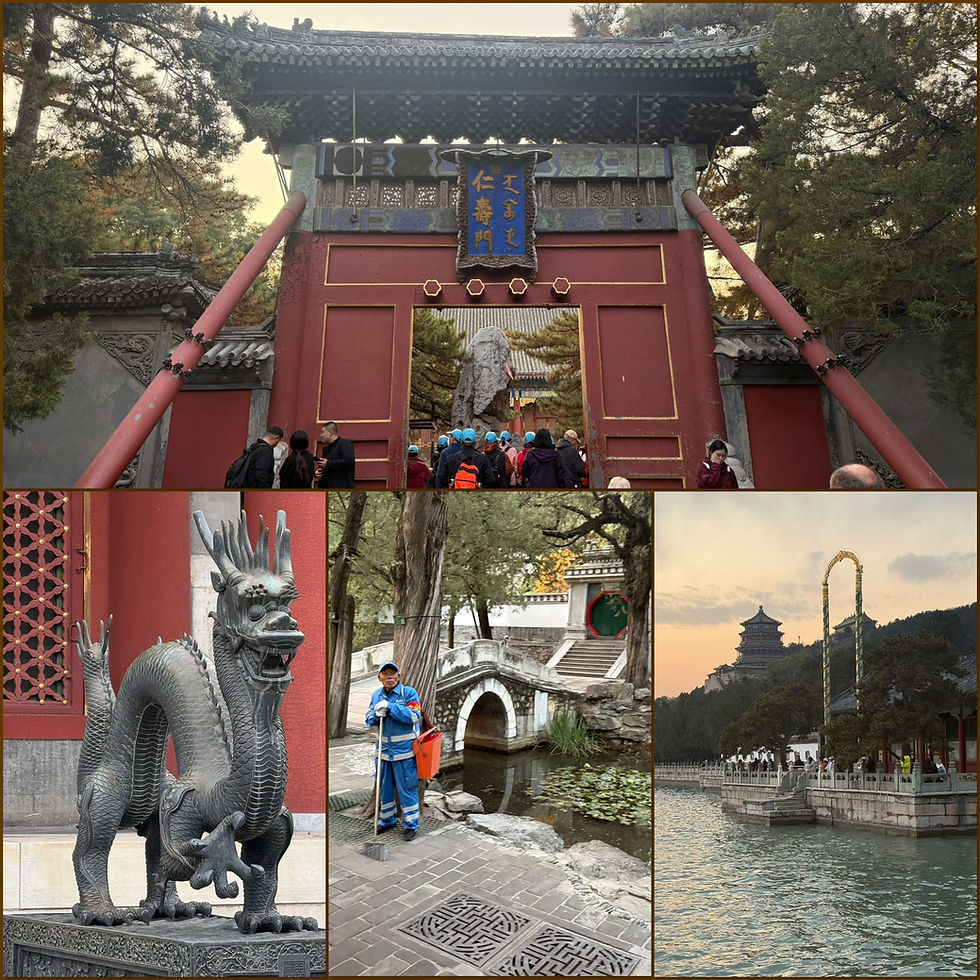
- a masterpiece of landscape gardening. World Heritage. There too, crowds of people we had to squeeze through. Security checks, showing passports, and the occasional face-to-face check became a standard part of almost every site visit during this tour.
Security & passport control: It's everywhere. Not just for safety, baggage, and so on. Museum visits are usually free here—great. But that personal security check? I don't get it.
The entrance is overwhelming, with its stately gate. Then we walk through a long, open corridor to the lake (220 hectares, 40% man-made), offering a perfect view of the surroundings and the temple buildings. The buildings displayed along the water harmonize beautifully with the surrounding landscape, inviting us for a group photo.

A meal follows with a dancer in a colorful costume who unexpectedly flashes his mask to his face and back. Once back at the hotel, almost everyone goes straight to bed because the schedule is relentless. Tomorrow, we leave at 7:30.
About schools and compulsory education
Compulsory education is free between the ages of six and fifteen. At fifteen, everyone receives

A life-defining, rigorous two-day exam determines whether you'll continue with three years of higher education (high school) or vocational training (learning a trade). Afterward, another rigorous exam determines whether you can attend university. A public university costs 5,000 yuan. A more expensive, private university can cost up to 30,000 yuan. Children can go to daycare from three to six at €200/month. But private daycare can cost up to €1,000/month!
While English is learned, they lack practical experience. This explains the Chinese's depressingly poor command of English. Sometimes Russian or Japanese can also be learned, but English is the primary language. Students can't decide for themselves when studying abroad.
About salaries and taxes

The average salary is around €2,000/month. But there are also higher salaries, up to €1 million/year. Taxes are 5%, for the wealthy 8%. Hello Belgium. Women are almost never housewives, which means that two people in a family earn at least 40 each. hours/day of work. Vacation is a maximum of 21 days. After ten years of work, ten days are added. China has a happy life, says Lin. She uses the word "happy" liberally in every argument.
Big Brother listening?
The copy industry
It turns out to be illegal, but no one does anything about it. And then our guide claims there's absolutely no difference between, say, an original Louis Vuitton and a fake—in fact, the fake is even better quality… Nella, my Italian wife, doesn't come around anymore…
Day 4: Beijing: Tiananmen Square, The Forbidden City, The Lama Temple and the Temple of Heaven.

Highlight day! We have to get up early to see Tiananmen Square (1417), Tiananmen Square , and the famous Forbidden City . Reservations are required for these visits. Massive groups line up in the adjacent streets before eight o'clock, from over a kilometer away.
There is a crazy atmosphere and everywhere groups are channeled along countless and endless lines of people walking along poles and barricades.

Just like yesterday, I spot countless prohibition and warning signs. "Don't do it" is the rule here. People of all shapes and sizes, wearing Adidas caps (an Adidas clone), uniforms, or historical robes. The square, with the obelisk at its center, the Monument of the People's Heroes (37 meters), is enormous, and the number of poles covered in cameras and loudspeakers is countless. Impressive. And... frightening.

Hundreds of guides with flags on poles hovered over the crowd. Everyone, their ears tangled, was swarming around. A semi-hysterical anthill.
We start at Zhengyangmen Gate (South Gate) After many rounds of queuing, a rigorous security check and passport check. A crushing impression. On the national holiday (October 1st), this square is filled with colorful groups – an impressive carpet of people. This, the largest square in the world, can hold up to a million people. Guards and soldiers everywhere.

It's clear that the April 1989 protest (the legendary photo of a man standing in front of a tank) had consequences. This was likely also due to a car bombing of a crowd by Uighurs in 2013 (five dead, 38 injured).
The square is flanked by buildings, mostly dating from the 1950s, including Mao Zedong's Mausoleum and the Great Hall of the People (310 meters wide and full of columns) the Chinese parliament, so to speak, where meetings of up to 10,000 people and banquets of up to 5,000 can be held. There is also the Museum of Chinese History and the former Beijing Railway Station.

“Gugong”, The Forbidden City (1406-1420) attracts at least 40,000 to 80,000 visitors every day. Beijing itself received up to 9.9 million inbound tourists in 2024. Hello my Bruges!
Surrounding the Forbidden City is the equally forbidden Imperial City, with everything within it to be completely self-sufficient.
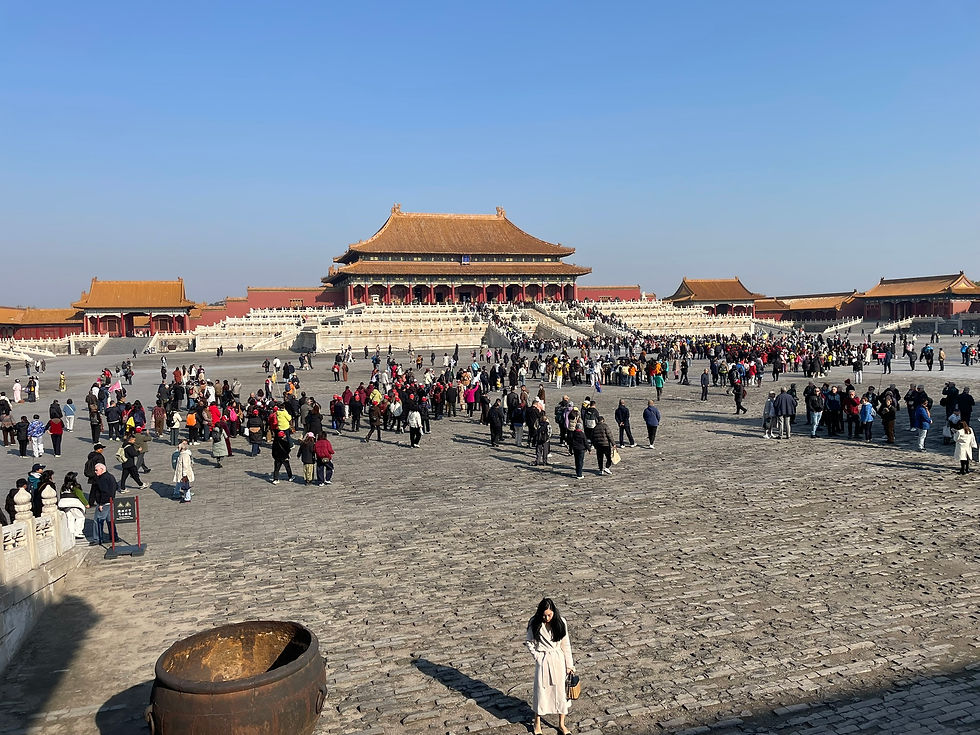
The complex is surrounded by a deep moat and ten-meter-high walls. At the Jin Shui Qiao entrance, the drumming is resounding. This Gate of Heavenly Peace was the place where Mao Zedong proclaimed the People's Republic of China in 1949 and later, in 1964, introduced the Little Red Book (with 427 quotations from the Great Leader), which played a central role in the so-called Cultural Revolution. Frontally, it features the famous, large painting of Mao's portrait, visible from afar. All of this breathes history once again.

The Forbidden City, also called the Palace Museum , was the former imperial palace of the Ming and Qing dynasties, the permanent residence of as many as 24 emperors.
It covers an area of 720,000 square meters, is 750 meters wide and 960 meters long from south to north, and has double, thick fortification walls with a gate at each cardinal point.
Divided into an Inner Court (where the emperor lived) and an Outer Court for a court of several thousand people.

The enchantment of this masterpiece of ancient Chinese architecture is simply overwhelming and a delight of harmony and symmetry, full of unique sculptures and masterful ornamentation (Unesco 1987).
The first flat courtyard is bisected by the Golden Water Stream, crossed by five bridges. Then, through a gatehouse, we enter a second courtyard surrounded by pavilions. Here and there are bronze lions, a crane, a 16.5-meter-long rock carving (1760), bronze bowls for firewater, and so on. A setting clearly designed to impress visitors.
Girls in historical concubine or empress outfits stroll through the frame in white or black dresses with mink fur collars, busy with their mobile phones, sometimes resulting in funny, anachronistic images.

More annoying is that miserable, crackling PA with speakers constantly blaring prohibition and other messages.
Little bridges over water and countless stairs. Walking through this imperial palace is a real challenge for those who are less mobile or tire easily. And you have to be careful; sometimes there's a steep slope between the stairs, which costs this idiot a painful fall.
The last part finally includes the graceful, voluptuous Imperial Garden , the only place where the concubines could enjoy themselves outside their own palace. In this Imperial Garden
trees that are up to six hundred years old.
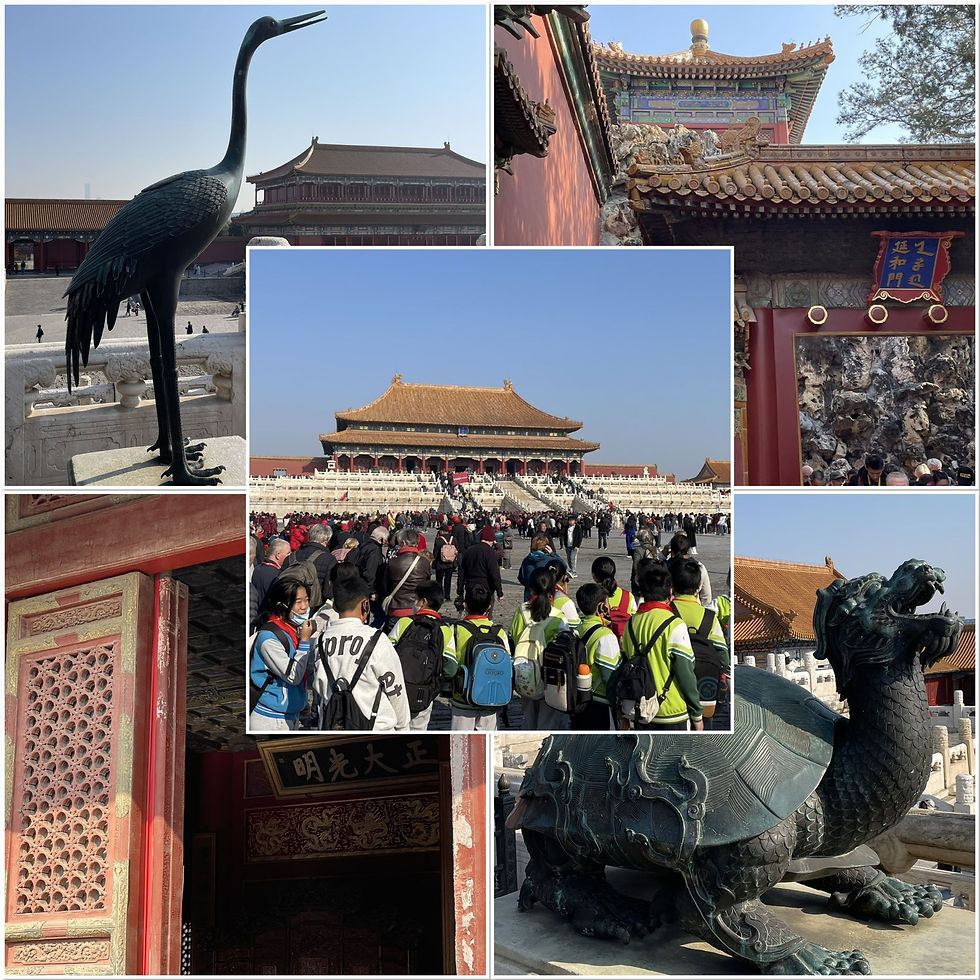
Once outside, we walk quite a distance to a spot where the bus is allowed to stop briefly, as they have nowhere to park. So, it's a constant back-and-forth between the guide and the driver. But we see glimpses of everyday life, a few Hutongs in narrow alleyways, small shops, and the many souvenir vendors with statues, lacquerware, photos, hats, and other knickknacks.
And then there are all those quirky forms of transportation: scooters and bicycles in all shapes and sizes. Some have gloved handles or even protective warm or plastic covers (winter = -15°C, remember).
The Lama Temple (Temple of Harmony) is the most beautiful of Tibetan Buddhism (1694).

Lama, think of the name Dalai Lama. Lamaism is prevalent primarily in Tibet and Mongolia.
Through a series of porticos, we enter a crescendo of curving buildings, decorated with beautiful yellow and green glazed tiles. We pass the Drum Pavilion on the left and the Bell Pavilion on the right. Four guards in polychrome terracotta are crushing devils. Whimsical.

Then we come to the sandalwood statue of Guardian Weituo . People worship the three bronze Buddhas of the past, present, and future on their knees, bowing with burning incense sticks that are later discarded in embers.
Moving devotion.

The most spectacular Hall of the Wheel of the Law contains a statue of Tsongkhapa , founder of the Hat Teaching , surrounded by monks' seats and, behind them, 500 Arhats (disciples). We conclude in the room known as the Tower of the Great Buddha, with an imposing 26-meter-high statue of Maitreya , carved from a single block of sandalwood.
The many colours, images and decorations stimulate the eyes and seem, to us Westerners, like fairy tales from another world.
We drive to the Temple of Heaven . Something completely different: circular, topped by ascending circular platforms with steps. It has something particularly charming. This is where the emperors came to pray to heaven for rain and bountiful harvests. The unique layout, building structure, and decorations hold an important place in Chinese architectural history. Absolutely photogenic and charming.

Yet, I keep thinking that this historical feast for the eyes clashes so strongly with the sometimes utterly bleak, gray, monotonous, "communist" residential towers everywhere. And yes, then you have modern high-rises, and the inner city is conveniently connected to the outer city by efficient traffic rings. And crisscrossed by super-wide streets with many lanes. But still, chock-full of traffic.
A tea ceremony follows . I was expecting something Japanese. Not so. Well, call it a demo and tasting session, sitting together at one long table with those small glasses. Various flavors are presented, accompanied by explanations and pouring demonstrations. Afterward, you can buy tea in the shop, but that's not very popular.
Night falls quickly, already at 5:30 PM. But the city is a colorful festival of lights. We close the

The day ends with another countless dishes on "the circle." And then comes the inevitable Peking Duck . You put a piece of meat and some vegetables on a thin sheet of dough and devour it. My foodie verdict? Well, I've eaten it before, of course, and prepared it myself, but I wasn't exactly impressed. Maybe it's just me.
The manager who constantly shouts instructions at his staff is annoying. I also get to know the local DMC (incoming agency) manager. Later in Shanghai, we'll share our experiences over a glass of Belgian draft beer. Well, as a B2B DMC agency, I only had Belgium. But he... all of China. Respect!

It was a really exhausting day. I walked 17,718 steps (12.79 km), and then you have to factor in that I held my phone, mounted on a frame for steady filming, almost constantly in my hand. I saw so many Chinese people today, in all shapes and sizes. But not a single chip shop! How come?
Day 5: Xi'an: Power banks, Terracotta Army, Bell Tower and dumplings
Once again, up inhumanly early to leave at 5:00 am with a packed breakfast for the

Domestic morning flight with China Eastern to Xi'an (two hours). Our suitcases were collected from outside our door during the night and, along with matching numbers, affixed to our passports. They are pre-checked in bulk upon arrival. We were specifically told beforehand not to put batteries or power banks in checked baggage, as all suitcases are subject to a rigorous security check. Anyone with anything suspicious in their suitcase is called upon to open it and explain their situation.
And then comes the security check. Every fiber of my being is checked and every piece

Luggage is mercilessly opened. The baggage distribution, the what and how, is much more thorough than the actually tame Zaventem. My backpack has to be returned three times, and then it happens. Our three power banks are retrieved and taken to a separate counter, where they are inspected and promptly charged "because they don't have a CCC label." My largest one, bought at Apple, made in... China, has a C. No idea what this is about. It's no use trying to convince us, let alone that we didn't know this. My: "Why..." Answer: "Because the Chinese Aviation Authority has decided so!" "You can buy a new one here." I lose my composure for a moment and raise my voice. A mistake, Wim. Never do that with Chinese people (and most Asians), I know, but I feel... robbed.

Many other fellow travelers are experiencing the same thing. Hopefully, this isn't a business model. When I consider how we allow our country to be inundated with all sorts of Chinese junk (hello Temu, Shein) and our businesses to be invaded by a country that doesn't shy away from espionage and infiltration, then... well, then... you fill in the blanks.
I already ran out of battery power yesterday during my shoots and I feel a bit “emasculated”

Before the gate opens, I quickly search for an electronics store to buy a new CCC. At an information kiosk, my question in English can only be answered via a translation app, back and forth. The store turns out to be at the very end of another terminal hall. I run, also on the moving walkways, reach the store, get a quick explanation, decide, go to pay, but it all goes wrong. I'm nervous, the keyboard for entering codes is completely different from ours, but I can't seem to get it right...
Nella calls: "Where are you, we're embarking?" I tell the salesperson "never mind" and start walking back. At the gate, Karin and an angry Nella are still standing. A private bus to the plane had been arranged for our group. We missed it. Karin says diplomatically: "I'll leave you alone for a bit." I endure the Italian fury.
In the end, everything went smoothly, as the local passengers were still queuing and there was still plenty of time. However, days later, I discovered I'd lost my credit card. I'd simply left it in that shop's payment terminal in my haste. Story of my life .
But through the local guide I can buy a new one on a Chinese webshop, delivered to the hotel as we speak .
Once landed after the luggage check (again in bulk directly to the hotel) we took the bus to Xi'an city center.
We visit a huge "art gallery" (clearly also a sales room) crammed with paintings, sculptures, interior pieces, and objects… Some typically Chinese, others more modern. There are some beautiful pieces, but I suspect they're all a bit of assembly line production. Other artworks, in my opinion, are downright kitsch. But once we're through, we're (again) "rewarded," this time with a Western/Eastern buffet.
According to our new guide, we should definitely try the local specialties we can find at quirky stalls: a kind of mini hamburger and a noodle soup (lots of noodles and broth, few other ingredients). It's clearly a place for tourist groups, as many other nationalities keep arriving. Meanwhile, I watch the legion of vendors waiting impatiently for us to finish our meal.
We leave the city center and drive to the site where the world-famous Terracotta Army is housed in three large hangars. Think of it as the Mausoleum of Emperor Qin Shi Huangdi .

This is Xi'an's main attraction, which, despite being the capital for a while, has thus acquired its cultural and historical significance. Once there, we first have to pass by demonstrations of how reproductions of terracotta figurines and the like are made into "souvenirs."
Once again, there are crowds of people to manage. We go through another thorough security and passport check, and then are allowed to take an open shuttle bus to the central square.
The first enormous main shed contains a wide and deep overview of the terracotta soldiers and horses dug in channels, as known from the famous photographs.

There are so many visitors that it's a struggle to get perfect photos of these wondrous excavations. But yes, what a unique, historical sight it is.
The Terracotta Army was discovered by chance in 1974 by farmers digging a well near Xi'an. It comprises 9,099 life-size terracotta warriors, chariots and horses, created for the first emperor of China, Qin Shi Huangdi, and his burial in the third century BC. It reflects the military might and organization of the Qing dynasty, and also illustrates the ancient Chinese belief that the afterlife is a continuation of earthly life.

You can walk all the way around the excavations, and there are places where you can see how the fragments are assembled. Some channel-shaped pits reflect entire scenes. Other images in adjacent rooms are displayed in glass cases. Surrounded by all those explanatory guides and their scattered group, everyone with earphones in. But I learn about the different hierarchies of the soldiers—the foot soldiers, the officers, and, at the back, the generals. The restorations are clearly visible.

A colossal undertaking that will endure for a long time to come. The statues (and their sheer number) are among the most impressive historical sights I've ever seen.
Emperor Qin Shi Huangdi's obsession with death manifested itself in his desperate quest for immortality through elixirs of life, which he attempted to create with mercury and jade. His obsession, along with his fear of dying and the power he might lose, led to the construction of his vast funerary complex, complete with palaces and towers, and thus also his Terracotta Army.

The emperor likely took mercury pills himself, sold to him by his alchemists as immortals. This poisoned him and ultimately led to his death at the age of 49. He was buried alongside thousands of soldiers, courtiers, concubines, workers, and their families. The famous Terracotta Army thus forms part of this tomb complex. But that entire life devoted to this obsession cost the lives of many thousands of workers…
*** See also Ming Tombs, Beijing, the day before yesterday.
No shuttle back, but an extra walk through a sort of entertainment, souvenir, and attraction village with—I even see some gambling palaces there!—we briefly check in at the enormous hotel, but then quickly head back to the restaurant for dinner.

This one is located by the beautifully lit Bell Tower in the middle of a huge roundabout and intersection of four wide avenues within the old city walls. On foot, we have to pass underneath via pedestrian tunnels. Again, we spotted girls in historical costumes posing with the magnificent Bell Tower in the background, usually encouraged by a boy, probably their boyfriend, who was eagerly taking photos.
We enter a sparklingly lit building via stairs outside, which gives us a beautiful view of this square with its magnificent yellow-orange tower monument.

The Bell Tower (36 meters high) is an iconic wood and brick clock tower dating from 1384, a symbol of the city. Originally used to tell the time and give warnings, it now houses a large bronze bell. The tower, a nationally protected cultural heritage site, was built during the Ming Dynasty and served as a ceremonial and timekeeping instrument.

Dinner introduces us to their specialty: dumplings in all sorts of creative shapes, colors, and flavor combinations. A feast for the eyes and palate. Back to our beautiful hotel, clearly in a more upscale neighborhood, we see beautifully lit parks and buildings that exude a sense of warmth and harmony. The hotel is enormous, with long hallways.
I'm having trouble with the Wi-Fi. Despite my VPN and Holafly , I can't seem to bypass the Chinese internet restrictions, which I could in Beijing. I try to explain it to the front desk. Of course, they ask (via a translation app): "Which programs?" Western social media is a no-go, I know, so I say: "Google." "It's prohibited, sir." Then I confess: "And with a VPN?" I get the expected answer: "Prohibited in China." They clearly have a better blocking system here in this hotel, unfortunately. That damned Great Chinese Firewall is not to be underestimated. On my way back, I pass a mobile robot that's responsible for... room service .
Day 6: Xi'an/ ChongQing: The Wild Goose Pagoda, Park with tai chi practicing elderly people, Muslim quarter, Chinese mosque, food streets and impressive city walls.

The Wild Goose Pagoda is a Buddhist five-story brick pagoda (64 m high) built in 652 AD during the Tang Dynasty.
Surrounding it are park areas that offer beautiful views of the surrounding city.
In the parks, retired seniors practice Tai Chi , an astonishing and beautiful spectacle.
Tai chi is originally a Chinese martial art, often practiced as an internal movement art for its health-promoting properties, but also for self-defense.

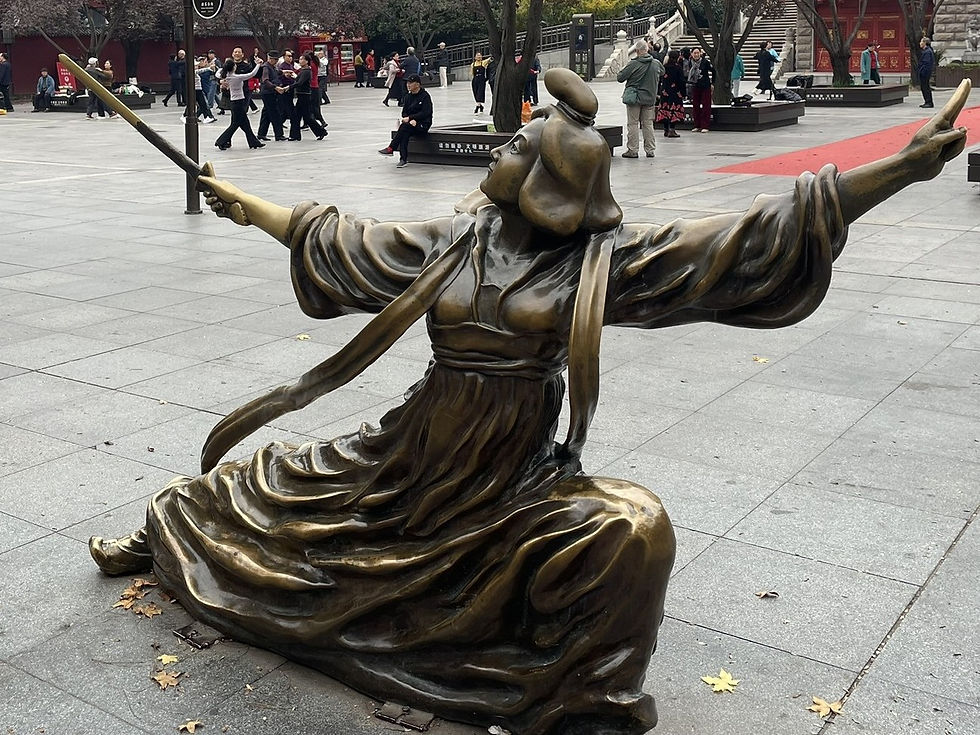
But other forms are also practiced: some move slowly and then quickly with a stick, others dance with a badminton racket. With long, multi-colored streamers, you have to wave them around without getting tangled. A man elegantly and with concentration hits a large top with a long whip. Behind him, couples practice all kinds of ballroom dancing, others dance to modern music. A couple simply hits some badminton feathers back and forth. And everywhere are beautiful (bronze) statues depicting ancient Chinese scenes.
It's a charming spectacle. It's clearly about harmony and balance. A brilliant idea, by the way. Although I don't see it happening in our little frog country anytime soon.
A little bit about pensions
Men retire at 60, women at 55. With the one-child policy, it was
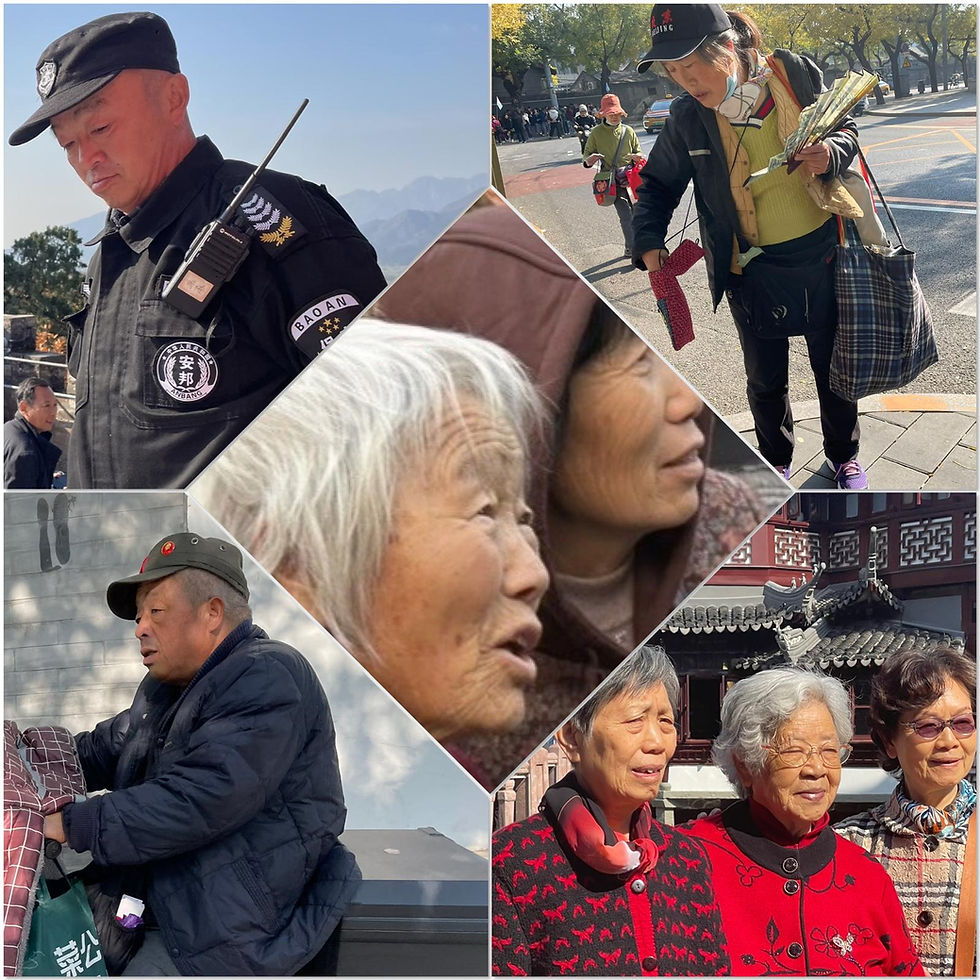
It was clear that the country was heading for an unsustainable aging population and thus a pension problem. The one-child policy was one of the biggest mistakes of the communist system at the time. Consider that people were even fined for having a second child. 45% of women had abortions at the time. The population shrank sharply, by 1.5 million per year, so that the age curve tilted drastically. Meanwhile, China had already been overtaken by the Dutch East Indies as the most populous country. Now, after this aging population, you even receive government support for having three children... Anything can change, said Bredero.
Back into the city, to the exceptional, and uniquely Chinese, Muslim Quarter . We pass not far from the Bell Tower, the equally magnificent Drum Tower , another symbol of this city. Make sure you read it carefully: the Drum Tower, not the Trump Tower (I couldn't pass this one up).

We head to the unique Muslim Quarter Where we'll visit a Chinese-style mosque. Unique, because it's completely unlike mosques elsewhere in the world.
A gate ornament flanked by typical "Chinese lion statues" marks the beginning of a festive street, a feast of colorful, twinkling lights, a series of street-food-themed shops. It's barely mid-morning, and already everything is in full swing.
I see local pomegranate preparations, candy fruit variations, all sorts of unrecognizable-on-a-stick, pancake-like skins, suspiciously simmering pots of broth full of fat eyes, ostentatiously carved, fried octopus and squid creations, ribs, drumsticks, boiled pig's feet and goat heads, strange breads—it never ends.
Also here and there you will find fancy hats and caps and classic trinkets aimed at tourists.
It's a relatively peaceful walk, though you should still be on the lookout for covered mopeds, scooters, and bicycles laden with crushed cardboard boxes. Street sweepers in fluorescent clothing are busy with long, tied-together brooms.
Suddenly, we have to squeeze through narrow, single-person streets and alleyways in a rather marginal, poor neighborhood, only to find ourselves lost in that côté, that so-called Grand Mosque . There's nothing mosque-like about it, as far as I'm concerned. And it's not really that big either. Everywhere are the same Chinese serrated roofs and curly pavilions, albeit in a narrower, landscaped strolling area. Quiet, enchanting, surprising. And a certain yin and yang feeling.
The Great Mosque (almost the only one in China)

Its construction was built during the Tang Dynasty (742 AD) according to the principles of Chinese architecture: several halls, built one after the other. The halls date back to the 14th century.
In fact, Chinese Buddhist temples were also constructed according to the same principle. A dragon, for example, can represent a minaret. Therefore, the Xi'an mosque doesn't resemble "standard mosques," although it does feature some "Arabic" decorations.
The mosque is still used by local Muslims for prayer. On an average day, around 500 worshippers attend, and on Fridays, up to 2,000. Some older people still speak Arabic, while younger ones no longer do.
But the overall impression of this place is rather cozy and charming and certainly not flashy and imposing like previously visited sites.
Back through the food spectacle street, we head a little further to one of the gates of the important city walls that once protected the old town. So, another climb up the stairs, but well worth it, with beautiful views of the old and modern city.

The original city wall of Xi'an was built in four years using earth, lime and
Glutinous rice extract. Later, it was finished with bricks. After the expansion, the wall became about 12 to 14 meters thick. It encloses an area of approximately 14 km³, 13.7 kilometers long. There are four main gates in the wall, with sentries stationed in three towers at each gate. Today, the wall is largely intact. You can walk the entire perimeter of the wall, but of course, we won't, because soon... the Yangtze River awaits us!
The lunch restaurant offers an imaginative buffet, decorated with a dragon, in a red carpet-like, vaudeville-style show theater with a stage, catwalk, and heavy red curtains. And unique in terms of show cooking : we see how meters-long noodles are stretched, cut, and cooked from a single piece of dough. A dexterity show in itself.
A little bit about Chinese cuisine (my opinion)
I have a love for Asian cuisine, but I would completely ignore the Chinese one I tasted.

At the bottom. Compared in terms of creativity, taste, presentation, umami, etc., to Thai, Cambodian, Vietnamese, Indonesian, Malaysian… I can't help it. Despite my open-minded love of world cuisine. As a bon vivant and amateur cook, I regularly venture into Eastern, exotic, exclusive dishes. But wildly chopped chicken legs, boiled meat in a broth swimming with obscure vegetables, and so on, seem unappealing to me, and some obscure dishes made me long for… flavor.

Then off to the airport. The same baggage procedure, suitcases immediately found in the cabin. Once landed in Chongqing , a drive follows through a spectacular landscape of highways and ever-expanding urban areas.
The city is located on the middle reaches of the Yangtze River and originated where the Jialing River flows into the Yangtze River.

These rivers are the foundation of the city's development. As a result, Chongqing became the first inland trading post, primarily because of its port. This made the city famous among foreign traders. It even served as the capital during World War II, during the war with Japan. Now, it is primarily a bustling industrial city. For example, it is the world leader in laptop production.
Along the way, we pass the world's largest overpass, a junction of highways connected by bridges. Impressive.

Arriving at the Raffles City quay, we see the Yangtze Explorer II moored under a large bridge like many more we will see.
The riverboat is moored at what will become a recurring feature everywhere, a kind of covered, floating pontoon. We reach the pontoon via a slippery staircase—it's raining—and a footbridge.

There, check-in, cabin access, and our first dinner on board in the Dynasty restaurant. Soft drinks, beer, and wine are included, but sparkling water is not—a Chinese riddle. Noteworthy: the waitstaff wears special, transparent face masks.

Meanwhile, the ship glides through the darkness past the spectacular skyline full of lights of Chongqing.
We settle in. Nella unpacks, I explore the bar. Noël Slangen, communications specialist and former political spin doctor, is a fellow passenger, and we start chatting about "the pleasures of a few drinks and our impressions of China." But bed soon beckons.
Another day full of impressions to process.
Day 7: Yangtze, Shibaozhai (271 km)
In the morning, there's a breakfast buffet, tai chi for those who enjoy it, a safety briefing, and a presentation of the ship by Assistant CD Nathalie. We'll be in the conference room. There's also a French group on board with CD Frédéric, and their information sessions will be held in the bar. Noteworthy
The Yangtze Explorer II can accommodate 129 passengers and has a crew of 130. That's a one-to-one ratio, a ratio that represents top-notch luxury on ocean cruises.

The ship, it turns out, has only been in service since May 2025. It has six decks, the lower one being for disembarkation and where you can play mahjong. On deck two: the restaurant and the reception lobby with, among others, guides Bernard and Mina in yellow jackets. Their purpose? They speak English.
Deck three houses shops. On deck four, we find the cozy Velvet Lounge with an espresso machine and a 110-seat theater. On deck five is the Explorer bar. Deck six is the open-air deck with the Pano Lounge, where Tai Chi is also practiced in the mornings. The cabins are spacious and comfortable, though they lack sufficient storage space. The heated toilet is Japanese-style with plenty of buttons that can be adjusted to clean, dry, and perfume with water. Yet, ultimately, an old saying teaches me: "No job is done until the paperwork is done."
About Chinese
China consists of 56 national, or rather ethnic, groups. Chinese people are difficult to read.


By that, I mean that expressing emotions isn't their greatest strength; their body language is completely different. This requires an adjustment on our part. One sore point is that they are very sensitive to losing face. They anxiously avoid vulnerability; they neither can nor will admit mistakes. Also important: the Chinese are chauvinistic. On their world map, China is central, not Europe. We are in the corner.
The Chinese are also very nervous, because they're constantly under stress. They have to study, graduate, find a partner, get married, have a child, keep their job, make ends meet, work their way up, and get rich. Burnout is simply not done. Or, at the very least, it will remain under the radar. And despite problems like high housing prices and such, there's a remarkable sense of optimism about progress.
It's wonderful sailing on the river. Yet, everyone is ready for the first lecture by Stefan Blommaert: " Evolution of Economy and Technology in China ." Informative, eye-opening, and insightful. My conclusion? We're behind it, folks!
We dock at Shibaozhai, which means Gemstone Fortress. In the afternoon we go ashore

across a footbridge on a row of pontoons. Several tuk-tuks await us there, from two-seaters to eight-seaters, but we stroll in a group through the village and its "Hello Street," so called because the vendors at all the shops say hello to get your attention. Specialties here are pomelos and oranges so juicy you can slurp them down with a straw.
The houses are usually true family homes, where three generations live together and care for each other—grandchildren and grandparents. Before we cross the bridge leading to the island, we notice statues representing the twelve Chinese zodiac signs: rat, ox, tiger, rabbit, dragon, snake, horse, goat, monkey, rooster, dog, and pig. I myself am a monkey. It's just like that.
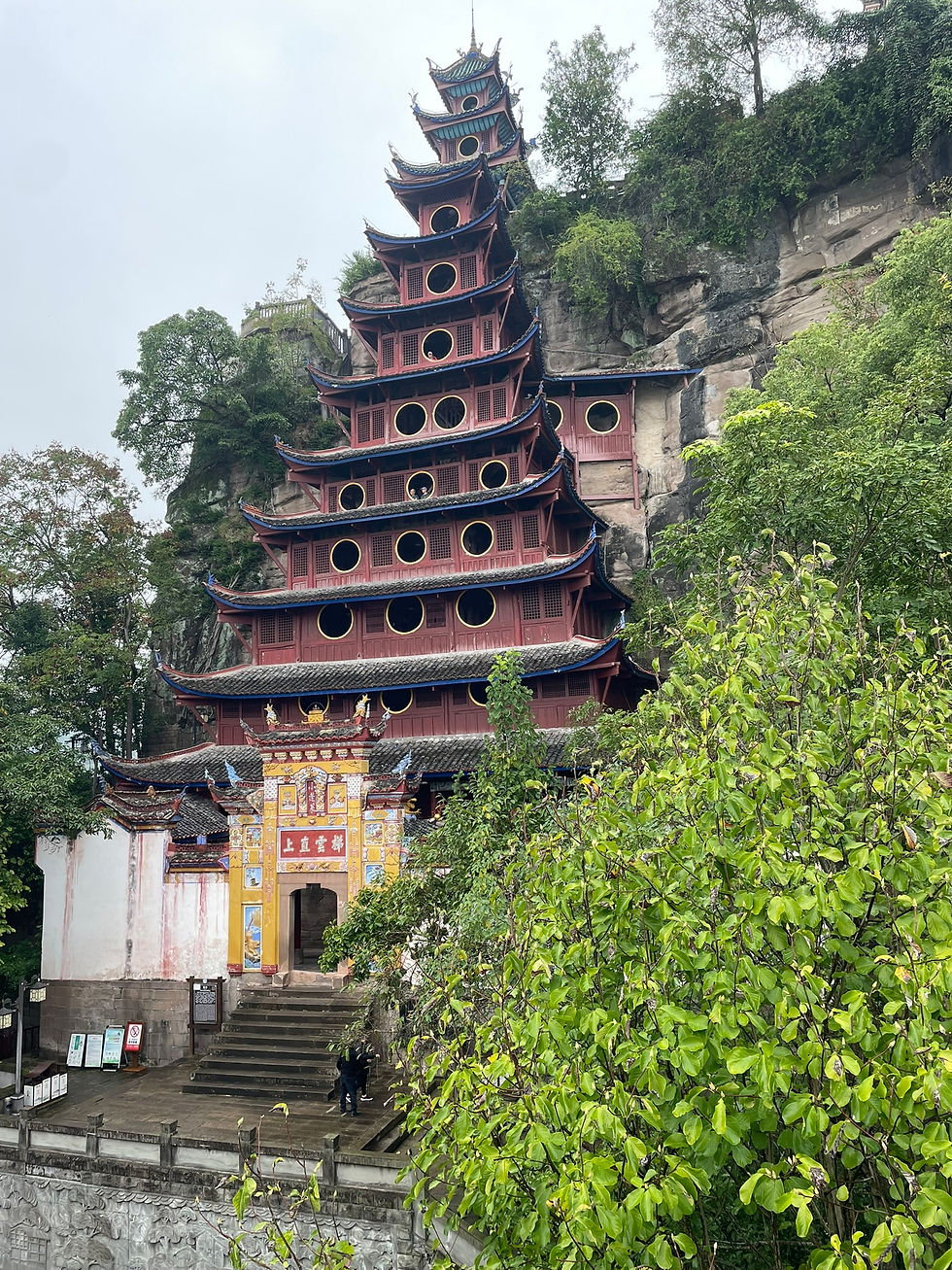
On the island hill, not far from the ship, stands a unique highlight: a nine-story pagoda topped by the Purple Rain Pavilion , a Buddhist temple. The structure is a marvel of engineering, clinging so endearingly to the slope of the island hill. You can climb to the temple at the top, from where a beautiful view awaits, even on a gray and drizzly day. I also learn that the water level here can reach up to thirty meters. In the past, there were also numerous floods, which have now been resolved by the Three Gorges Dam. *** See tomorrow.
The red wooden pagoda is an important historical and cultural monument and a popular tourist attraction, known for its remarkable architecture, frescoes, and stunning views. Legend has it that the hill was formed from a stone left by the goddess Nüwa after a celestial battle.
We sail on to Wushan (490 km).
There will be a short workshop with a demonstration of silk embroidery.
In the evening

we were invited to an aperitif of rather tasteless sparkling wine, followed by a speech by the captain in Chinese, translated by an assistant. Several crew members were introduced. Petchi and Ladi, a Filipino musical duo, began performing. But the singer regularly lashed out with ridiculous, annoying, and exaggerated tremolos. And three giant pandas joined in, dancing and hopping, which I immediately captured on video to send to my granddaughter Sofia.
Day 8: The Three Gorges: Xiling, Wu and Qutang, Wushan, sampams and snub-nosed monkeys
Early on, we sail through the first of the famous three gorges, the Qutang Gorge . It's short and narrow, but therefore quite spectacular. It gives me a kind of Norwegian fjord feeling.

We dock in Wushan and transfer to a sightseeing ferry that navigates the " Three Small Gorges " in the Daning River tributary. I secure a strategic spot for photo and video shoots because it looks promising: mountain peaks shrouded in a mysterious mist, green hills and rocks covered in lush vegetation and waterfalls.
Along the way, I'm once again amazed by the many bridges and train connections, here too. China is truly a kingdom of overwhelming infrastructure. A country clearly governed by... engineers. But now, for a moment at least, more pure nature.

Halfway up, and later in other places, we notice caves in the rock face—caves, really—containing wooden coffins, an ancient burial ritual of the Bo people, for the wealthy. This brought them closer to heaven. A silent testimony to a thousand years of human activity. Although it's surprising how they got there with those steep walls.
No one knows exactly how they did it, yet another mystery.

We end up at the Maduhe River , another tributary where sampans await us for further, even closer exploration. We cross, and the portly guide turns out to be an entertainer who even gets us singing along to a Chinese song. He challenges me to sing too, and before I know it, I start singing: "And we're not going home yet!" The whole boat joins in: "Not by a long shot, not by a long shot." Yes, the atmosphere on board this wonderful river trip is truly vibrant. On the return trip, we spot a few snub-nosed monkeys on a rope walkway. We hop back on the ferry, back to Wushan.
Later in the afternoon we sail through the Wu Gorge with fun names like the Peak of the Climbing Dragon , the Peak of the Goddess and the Peak of the Flying Phoenix . Later we pass the longest, last gorge, the Xiling Gorge. We eat early because around eight o'clock we arrive at the famous Three Gorges Dam with a unique passage through the gigantic hydroelectric boat lift , the largest and most technical in the world. Not to be missed.

It's quite exciting, even eerie, entering it and then slowly descending over such a height, only to see the view of the river, much deeper, slowly emerge at the bottom... A unique, spectacular experience.
The Yangtze Explorer II is one of the world's first luxury cruise ships, specially designed (140 meters long) to navigate this globally unique structure. Under optimal conditions, we'll explore (for about an hour) this largest and most technical ship lift in the world. It's a key component of the Three Gorges Dam project and requires an extremely precise technical challenge. Engineers are using a massive gear and rack system, supported by 256 cables that operate in perfect synchrony.

This system functions as a kind of solid, vertical railway for ships up to 35,000 tons. The chamber containing the ship and its water volume is thus raised or lowered 113 meters (the height of, say, Bruges's Church of Our Lady) with millimeter precision.
It's an experience like a perfect concert of human expertise, craftsmanship, and the spectacle of nature. A unique experience that lasts 40 minutes, considerably faster than the traditional locks. The original five-stage locks took three to four hours. The boat lift is therefore a faster alternative. It's worth noting that the engineers drew inspiration from the Belgian boat lift in Strépy.
On the outer deck, I meet Dr. William Van Impe , Emeritus Professor at Ghent University (Faculty of Engineering and Architecture and Director/Head of the Soil Mechanics Laboratory), who shares more details, insights, and facts about other earthworks and their geotechnical specificities, such as the support for the Tower of Pisa. I'm impressed that such an authority is present as a passenger at such a special moment.

The Three Gorges Dam in the Yangtze River is located in the heart of China and was built in phases between 2003 and 2012. This monumental structure is a feat of modern engineering that rivals the Panama Canal.
The Three Gorges Dam is the largest hydroelectric power plant and dam in the world. It was built to control flooding, generate clean energy, and improve navigation.

The dam itself already produces 1% of all China's energy. And there are plenty of other dams here. Solar panels, for example, are a booming business (currently: there's overproduction due to oversubsidization, the sector is in crisis...).
Construction began in 1994 and was completed in 2006. The project also included the construction of a massive reservoir, which resulted in the forced displacement of over a million people, all of whom had to be compensated and resettled. Depending on various factors, the locks and lift can handle up to 120 vessels per day. Reservations are required.
What a day full of special experiences this was!
Day 9: The Three Gorges Dam + Museum

We arrive in Yichang around 1:00 AM . After breakfast, we depart by bus, an hour's drive. We first visit the museum (2022), which provides us with a comprehensive introduction to this remarkable project through various audiovisual displays. We are blown away by the sheer number and superlatives. What an undertaking! Afterwards, we stroll through a park with other pieces reminiscent of these works, such as trucks and excavators. At the river's edge, we get a frontal view of this impressive, wide dam, with the five-stage locks a little further to the right.

The dam is 2,335 metres long and 185 metres high, with a reservoir that stretches over 600 kilometres

reaches inland. It contains 34 turbines, consisting of 32 main generators of 700 MW each and two smaller power plants, resulting in a total capacity of 22,500 MW. It put an end to the problems of flooding and navigation restrictions, as it enabled control over currents, hydropower, water resource use, and improved navigation and ecological and environmental protection.
Back on board, an acupuncture session is scheduled, followed by the second lecture by Stefan Blommaert on "The Omnipotence of the Chinese Communist Party." And in the evening, the film Red Cliff . I use the finally free time to catch up on writing and edit photos and videos—a seemingly hopeless undertaking.
Day 10: Wuhan, The Pavilion of the Yellow Crane
In the morning, lecturer Stefan will give a short “Introduction to the Chinese language” in the bar.

Chinese has 400 sounds and 40,000 characters (!), of which 8,000 are known to "university people" and the average person knows about 4 to 5,000. But a word can have up to ten different meanings, depending on the pitch and the accent placed.
There will be a presentation and demonstration of the interior paintwork by "Hengshui." But I'm already looking forward to the third lecture, "The New Silk Road – Global Chinese Investments."
Conclusion: China is quietly taking up important strategic, economic and geopolitical positions.
We arrive in Wuhan around three o'clock .

Wuhan (population 10.5 million) was once home to foreign trade concessions due to its very central location and the river. The region has also seen numerous armed conflicts. And, of course,… known for the outbreak of SARS-CoV-2 (Covid-19). Popular dragon boat races are held here in May. The biomedical and pharmaceutical industries have a strong presence in Wuhan. For example, they copied the originally Belgian Fentanyl (Janssens Pharmaceuticals) here and now have the largest production after Shanghai. Shipbuilding (with links to the Netherlands) also proves important. In summer, temperatures can reach 40°C here, but in winter barely drop to 0°C, with the transitional seasons being rather short.

We will take the bus (30 min.) to the emblematic Pavilion of the Yellow Crane Boat guide Bernard: "How do you know you're in the center of a Chinese city? When you see McDonald's, Walmart, Burger King, Starbucks, and so on." After Deng Xiaoping, Western worship became a reality. Our beauty ideals, too: women minimized their slanty eyes, raised their noses, and enhanced their cheeks, like Victoria Beckham.
Once we arrive, we head to a minibus station, from where we take small, open-top trams to the foot of the Pavilion. A few show-offs walk.
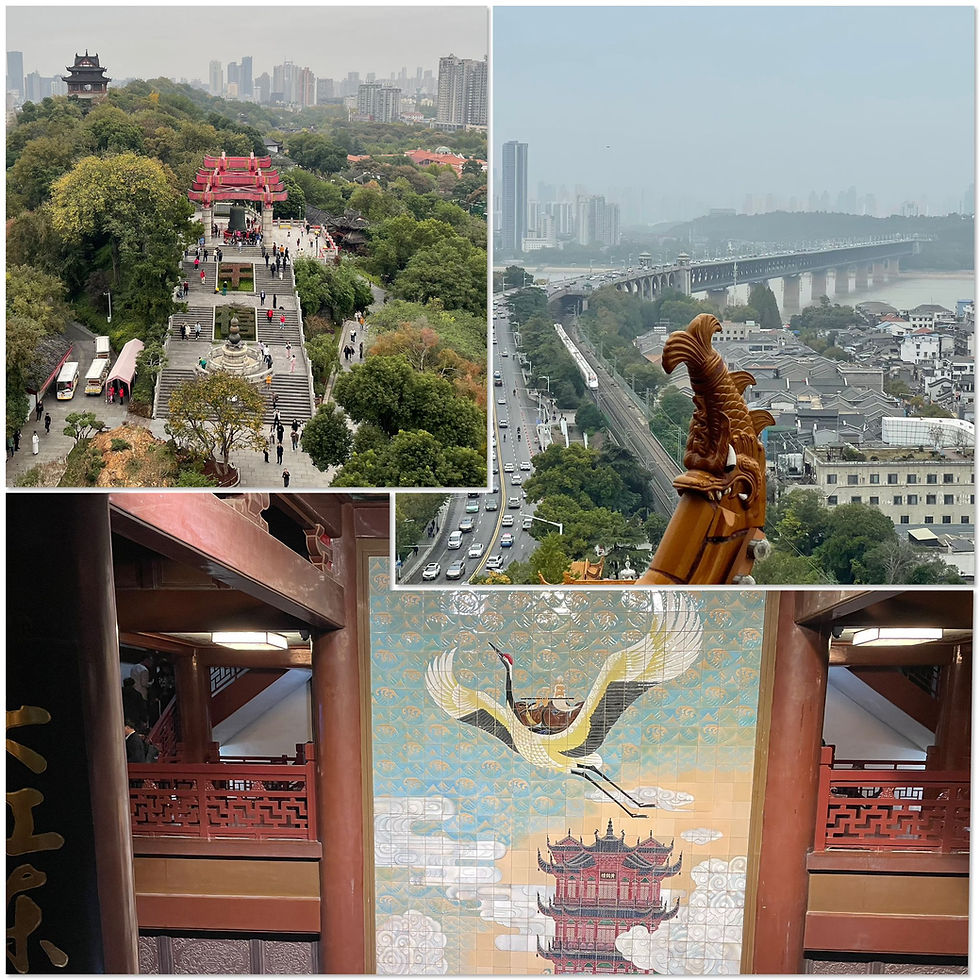
The Pavilion, rebuilt several times, has five floors (180 steps), but there is also a rather rudimentary elevator. Fortunately.
The remarkable building proves to be a valuable monument to Chinese art history. And from above, we have a magnificent view of the city with its skyscrapers and the Yangtze River.
The Pavilion of the Yellow Crane is an iconic monument, known for its architectural beauty and its role in Chinese poetry and legends.
The tower is known for its impressive traditional Chinese architecture and is an important landmark in the city.
On the way back, we grill Bernard with questions about Taiwan and Hong Kong. The most exciting one concerns the origins of Covid in this city. Bernard, a champion at dodging and skirting difficult questions, claims almost openly that it was due to Americans attending a conference here at the time. Just look at that...
Due to the coronavirus outbreak, the city was placed under total quarantine in January 2020. This totalitarian, zero-COVID policy was much stricter and longer than ours. There were reportedly around 168,000 infections. The paralyzing isolation took a severe toll on the lives and spirits of local residents. Now, they are experiencing a 5% growth again.

On the descent to Jiujiang (490 km), it's already dark, and the facades and flanks of many buildings along the river are illuminated by moving, color- and pattern-changing displays of light. Magalie announces the descent on the PA as a " funeral ," haha. No one notices. This former broadcaster, however.
It is a colorful feast for the eyes, not to be missed, because during the day Wuhan seemed a banal, gray modern city.
There's an information session with Magalie, because the next day promises to be a bit more complicated. That evening, there's karaoke in the conference room. Not much of a song selection, but there's plenty of singing going on...
Day 11: Jiujiang, Cable Car, Lushan National Park, Meilu Villa, Huiling
At 7:45 a.m., we depart by bus to the Lushan National Park cable car station (Unesco) (35 minutes). Then, we ride the funicular for ten minutes to the mountaintop. Each cable car holds about 25 people. From there, we'll be transferred in tourist carts to a flower-filled path along the edge of a small lake. We'll walk along stairs and paths through a section of the charming park, dotted with rocks adorned with Chinese symbols, bamboo, sophisticated signage for the numerous hiking trails, charming springs, and a wealth of unique trees.

The name Lushan means "Mountain of Straw Huts" and overlooks Poyang Lake to the south and the Yangtze River to the north. The mountain is considered one of the most beautiful in the country and therefore attracts many Chinese tourists. Strange peaks, steep cliffs, unusual rock formations, clear lakes, waterfalls, and caves, all topped by a constantly moving symphony of clouds. The highest peak is 1,543 meters.
In the second half of the 19th century, Lushan became a resort for the wealthy, government officials, and foreigners. Most were carried up a steep nine-kilometer path in a sedan chair. This included Chiang Kai-Shek, who had his summer residence there (see below). There are approximately 200 historic buildings. The location is also considered the cradle of landscape art and pastoral poetry.

Then follows a longer hike, about a thousand steps, through the Yingxui Valley . It's said to be always full of flowers and offers spectacular views. But it's a foggy day, so unfortunately, there are no panoramic views. I walk a short distance to two important viewpoints, including the Heavenly Bridge (two rocks reaching towards each other—who wants to jump?), but then I turn back to take the bus with some others to the end point. There, we can descend to the Moon Gate , which leads further to the Cave of the Taoist Immortal .
We meet some Taoists, some nice photo moments and a halting conversation

yields. They teach me, among other things, how to fold my hands in a Chinese gesture of gratitude. The cave and the religious Bamboo Forest Temple are intimate and charmingly beautiful, like the altar with statues where our three Taoists pray, bow, and burn incense.
We'll have lunch at the Long Hao Holiday Hotel , where meat is hung outside to dry. The afternoon will be dedicated to a visit to Meilu Villa .

This is the mountain's most famous villa, built in 1903 in European style by a British woman. The building hosted important meetings of the Chinese Communist Party and served as a residence for leaders such as Chiang Kai-Shek and Mao Zedong.
The guide confronts me with a piece of completely forgotten secondary history. About Kuo Min Tang, Zhue Enlai , the Sino-Japanese War, the secession of rebellious Taiwan, and so on…
Villa Meilu boasts an elegant style with an open terrace and verandas, surrounded by a garden with beautiful magnolias and American trumpet vines with trumpet-shaped flowers that attract hummingbirds. The outdoor pool, the spring, and the bamboo grove in the garden are all still as they were in the past.

We return to the village of Huiling . A village surrounded on three sides by mountains, full of beautiful villas in an eclectic style. We have some free time to wander the streets lined with shops. It's cold, and unfortunately, most shops cater to Chinese tourists. Dried meat chunks in plastic bags or metal cans... anyone?
Finally, we descend again by cable car and are taken back to our ship by bus. Around four o'clock, the ship departs for Nanjing (445 km).
We attend an informational meeting about disembarkation. Onboard bills need to be paid, and suitcases need to be packed. We're invited to the reception hall for a brief moment, where a traditional Lion Dance parade takes place. A red and a yellow lion dance around the crowd to the sound of drums. Then we lie down on the floor, ready for a photoshoot. A nice touch of Chinese folklore.
After the farewell dinner, the crew will give a show in the conference room. It's touching to watch the stewardesses and other crew members perform some Chinese dances in costume.
Day 12: Nanjing, HST train, Shanghai
Suitcases must be left outside by 9:00 AM and the cabin must be vacated. At 10:00 AM, Magalie will present the upcoming Knack Travel offer, followed by an informal Q&A session with Stefan and Bernard, which will provide some additional information and insights, such as: What can we learn from the Chinese?

Time to say goodbye to our week on this river. I found the Yangtze River, aside from the Three Gorges Passage, less beautiful compared to, say, the Douro, Danube, Rhine, Mekong… I did pass under more bridges here than in my previous life combined, haha, that's for sure. But don't get me wrong; with Beijing, Xi'an, and Shanghai thrown in, it's a fascinating travel package, definitely worth it.
Did you know: On the Yangtze we laid a total of
1,985 km away (that's roughly the distance as the crow flies between Paris and Kiev).
In the afternoon, we arrive in Nanjing , a wealthy megalopolis. We take a bus to the Dai Pai Dang restaurant , followed by an exploration of the historical and cultural city of Nanjing. Fortunately, they serve the Tsingtao beer, a beer we're also familiar with, a real pilsner instead of a bland flavor.
Nanjing was the capital of China ten times and witnessed the so-called Golden Age of the Ming Dynasty and the birth of the young republic in 1911.
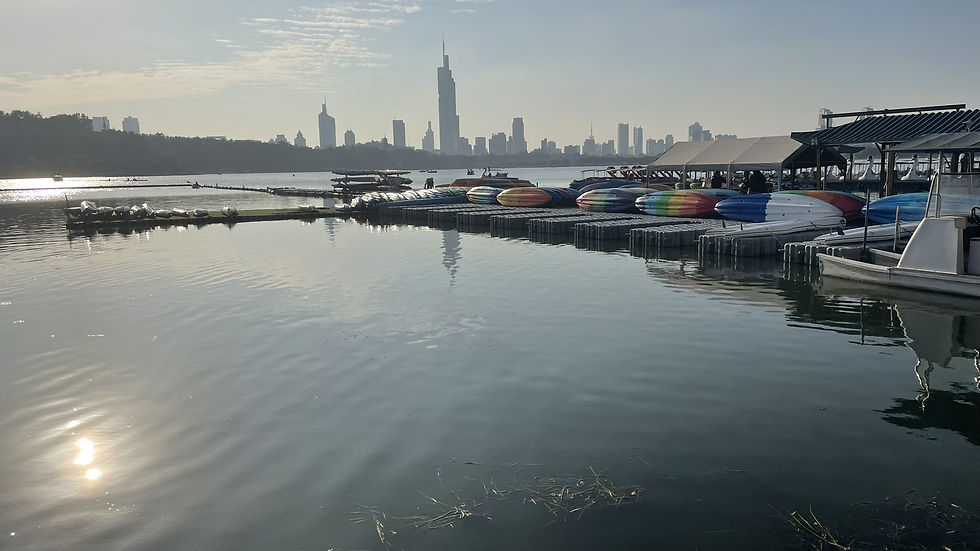
We head to the expansive Xuanwu Lake, which lies in the middle of the city. It's clearly a recreational park with rowing boats, tour boats, tourist trains, and so on. On the way to the train station, we catch a glimpse of the Ming Dynasty's city walls, the longest in the world. Our guide rattles on and on. I fear for a moment she's about to run out of breath. "So..., so..., so..."
We disembark at the impressive Nanjing station (more of an airport feel, with yet more security checks and crowds). From there, we'll take the high-speed bullet train to Shanghai . Amusingly, a robot roams around the station, covered in cameras and emblazoned with "Police!"

Note: So much advanced technology, applied everywhere, and our reality usually already ahead of its time, but public announcements are terrible. It's incomprehensible that they're always too loud, especially garish, and overdriven.
The journey takes barely an hour and a quarter. The train reaches speeds of up to 340 km/h. The fixed, numbered seats in second class are spacious, comfortable, and offer fast Wi-Fi. There was some animosity beforehand, as we were urged to board very quickly. The train runs on a tight schedule.

HST business class even has meeting rooms and computer facilities where CEOs can quietly do their thing. The HST also has the advantage that they can operate during typhoons, while airplanes cannot.
China's railway network covers approximately 40,000 km. This will likely double soon, and the Maglev train, capable of speeds of up to 505 km/h, will soon be available.
There are twice as many high-speed train lines in China as in the rest of the world.
Arriving in Shanghai, we take a bus to the Amara Signature Hotel (30 floors), where we also have dinner, an international buffet. Our modern room offers another view from the bed of an open bathroom, where you can admire your partner bathing, but also sit… you know. There's a hidden curtain switch, though. Turning on the lights is a bit of a headache, because one automatically turns off the other. It's a bit of a puzzle… Chinese style.
Day 13: Shanghai: Jade Buddha Temple, Shanghai Museum, Silk Factory, The Bund, Nanjing Road
Our guide introduces herself as Fiona, though her name is May. A cheerful, friendly child, she was the best and most fun guide on the trip. We each received a card with the words "I'm lost. Help me. Call my tour guide, Fiona, at ..." in Chinese and English.

Shanghai is the economic capital (population 24.9 million, metropolitan area 41.6 million) in the country's most prosperous and expensive region. A house, an apartment, costs an average of €15,000/m². It's the world's largest port city, located on the East China Sea. It hosted the 2010 World Expo. This city is clearly "open to foreigners." Only half of the population are truly local Shanghainese; the rest come from abroad.

Shanghai is bisected by the Huangpu River , with the old city and the Bund to the west and the modern financial district of Pudong to the east, with its four famous skyscrapers: the characteristic Oriental Pearl TV Tower, the Shanghai World Financial Center (the “Beer Bottle Opener”), the Jin Mao Tower (the “Pagoda Tower”) and, since 2015, the Shanghai Tower (632 m).

Some random, fun facts :
- Shanghai has 635 Starbucks, every four minutes a bullet train (340 km/h) leaves for Beijing (journey time: 4.5 hours).
Chinese people work there 5 to 6 days a week, at least 8 to 10 hours, and sometimes 14 hours a day (e.g., internet companies). The so-called 996 system: from nine to nine, six days a week.
- In November 2024, three typhoons occurred in ten days.
Dozens of bridges and tunnels cross and cross the Huangpu River. Some were built in just a few years (plus the subways and ferries). Hello Antwerp.
Besides the many metro lines, there are also thousands of bus routes, taxis, and bicycles, of course. However, traffic is a real pain point here.
About tea, coffee and Starbucks.
China. You're thinking tea? No, not at all. The mere presence of Starbucks tells a different story. The introduction of McDonald's and KFC was a cultural shock at the time. Queue up, order, then find a seat, get a number, clear your own table? But it was a disaster for the cozy local coffee shops and teahouses of the time. But apparently, there's a retro trend with "Lucky Coffee." Back to cozy, service-oriented, and cheaper, apparently. Let's hope so.

Our first visit, the Jade Buddha Temple It's well worth it. We wander from one building to the next. Each hall offers a different Buddha statue or monstrous warrior, and so on. There are also many porcelain ornaments, old paintings, and Buddhist scriptures.
The Seated and especially the Reclining Buddha (in a "happy resting pose") are made of sparkling white jade and surrounded by a mantle of precious stones, primarily agate and emerald. Truly admirable.
The ancient style Chinese temple architecture contrasts sharply with the surrounding modern high-rise buildings.

The Jade Buddha Temple is a large Buddhist temple dating from 1882, built in the Song Dynasty style, dedicated to two jade Buddha statues brought over from Burma by a monk. Over 7,000 Dazang sutras (scriptures) are preserved in the Jade Buddha Tower, all priceless cultural relics .

Suddenly, two officers jump aboard our bus. One even wears a black mask. Apparently, a drone (?) spotted that some people on our bus weren't wearing their seat belts. How that's possible, I have no idea. I can confirm the drone. A kind of camera was immediately attached to the windshield. The driver and our guide, May, have to show their papers. A report is drawn up. Based on the passenger list (a wrong one, by the way, haha ), a printout is made with a handheld device for each person present, 34 of them, all to be signed by May, who later sees the humor in it. On every subsequent trip, she announces: " This is your captain speaking, fasten your seat belts ." The intervention itself turns out to be a warning. Next time means a fine.
You wouldn't believe it, but five minutes later another officer jumps on the bus and reprimands our guide for speaking standing up. He sprints through the bus, looking for victims without seatbelts . None. And May? She gets away with it by saying she was just checking everyone for seatbelts. The guts! A bit of a nitpick.

In the city center, I see a giant billboard featuring top footballers Messi, Yamal, Wirtz, and… Doku, all in their national T-shirts. Just look at that…
We pass the Shanghai Museum on the edge of the central People's Square , a must-see for history buffs.
However, we visit the East Campus in Pudong, the commercial and financial heart of the city with the Stock Market and the Bank of China.
First, we'll do the Sky Walk , which, in my opinion, is nothing special; you just spiral down a few floors. But this very spacious building (33,000m², six floors) with plenty of natural light contains extensive, sometimes priceless, collections spread across five floors, all accessible via ramps, escalators, and elevators. There are loads of schoolchildren milling around in that enormous central hall.

There are thirteen permanent and three temporary collections of Chinese painting, sculpture, and calligraphy, as well as galleries dedicated to seals, jade art, coins, bronzes, and other ancient sculptures, as well as a gallery of Yuan-Ming-Xing period utensils. The collection comprises over a million items, of which 140,000 are considered national treasures.
People's Square is the geographic heart of Shanghai. The subway station beneath the square is where three lines intersect. With 700,000 passengers per day, it's the busiest station in China. The enormous square is a favorite hangout for locals, who enjoy strolling and lounging. The benches are usually occupied by elderly people, well-equipped with thermoses of tea and blankets.

The marriage market , held every weekend from 12 p.m. to 5 p.m., is a fun and unique experience . Parents and grandparents search for a good match for their adult children. Armed with flyers containing information such as height, weight, education, job, income, and star sign, they usually try to "get their son married."
China, for example, has a surplus of men, a legacy of the one-child policy. In China, parents feel responsible for their children's marriages. An unmarried son means losing face. Young Chinese women, on the other hand, are allowed to be choosy. If they earn a good salary, many women delay marriage.

Near People's Square we will have lunch at the Shanghai History Museum , formerly the
Shanghai Race Club , a rather monumental colonial building with a prominent clock tower. The restaurant exudes the old Victorian charm and ambiance of cigar-smoking lords in Chesterfield chairs , enjoying tea with scopes or fine whiskies. A few floors up, we even walk through a rooftop garden and terrace to reach the dining area. This terrace offers a nearly 360° panoramic view of the city.
We had to specify our main course beforehand. Karin said: "There's a choice between fish, lamb, and... beef." Beef? She must mean beef. That's my choice too, because it's Wagyu. Yum, Japanese super beef .
A visit to a silk factory is a must. The production process is explained
From the caterpillars crawling on green leaves to the pupation and the machines that pull threads, then stretched into duvets and pillows that we can open and unwrap together to demonstrate that everything stays together nicely. Of course, other items, clothing and such, are also offered for sale in the shop.
"Chop chop!" On to the highlight of the day: the Bund , with its elegant colonial, British-style buildings along the Huangpu River . And especially, the iconic image of Shanghai: the view of the skyline, with the four skyscrapers of the Pudong business district from the Bund. While the Bund's waterfront showcases the heritage of the past, the other side represents the future.

We squeeze through the crowd to the edge of the wide promenade to take a selfie with that stunningly unique view.

The Bund is a kilometer-long, wide waterfront promenade between the Huangpu River and Zhongshan Road. Its name is related to the Dutch word "band" and refers to the raised quay. In the nineteenth century, this waterfront boulevard was home to banks and trading houses of England, France, the US, and Japan, including Royal Dutch Shell, HSBC, and the Bank of China. There's also a miniature Big Ben with a distinctive clock and the old customs house. This stretch of riverfront along the Huangpu was then the financial heart of Asia. The buildings are a mix of styles from the 1880s to the 1940s. After the Second Sino-Japanese War, virtually all foreigners left the Shanghai settlements.
Pudong, across the river, was a slum until the mid-twentieth century. In 1990, Pudong was designated the city's new business district. And that's where those imposing skyscrapers, such as the unusually shaped Oriental Pearl TV Tower, emerged. It's perhaps the most impressive skyline on earth and very popular with Chinese tourists, who want to have their picture taken with the icon of their economic miracle.
After dark, the skyscrapers are illuminated with flashing neon lights that reflect in the Huangpu, making it another must-see and photo opportunity .
Time for some free time and shopping. It's impossible not to shop in Shanghai. Shopping is the national religion here, and the city is a shopper's paradise. We cross the street. We meet at the Peace Hotel with its old British charm. This is where the main shopping street, Nanjing Road , begins . It's practically Shanghai's Meir, a pedestrian zone bathed in bright neon. It's always been the main street, and now it's a busy, expensive street with gleaming malls, shops, offices, and hotels. We have 45 minutes. I buy an extra top-of-the-line power bank. CCC, of course.

If they want to show off anything here, it's that they have money. There are crazy-rich Asians showing off their expensive Italian and German cars at the traffic lights. There are modern, confident young women, sharply dressed and a head taller than their parents. I've seen so many shops in China with a strong presence of Western luxury goods that I think consumerism is more extreme here than it is here.
Although the economy has been slowing down recently because, believe it or not, the Chinese are reportedly not consuming enough.
But far below the nouveau riche, rural immigrants toil. Millions of fortune seekers, immigrant workers from all corners of the country, live and work in Shanghai. They try to send as much money home as possible, often separated from their families for months at a time, living in ugly apartments that resemble birdcages. They often work the real menial jobs, like delivery. An army of tens of thousands of delivery workers ride around Shanghai on scooters, laden with packages and meals.

After our free time, and some more views of the fascinatingly lit Pudong, we go to Meilongzheng restaurant for dinner , where there is some confusion about whether beer is included or not, and then to our hotel.
Day 14: Shanghai Tower, Old Town Nanshi & Bazar, Y Garden & Chenghuan Temple, French Concession, Louis Vuitton ship

We decide to start with the Shanghai Tower . It's the second tallest in the world (128 floors). First, security. Lighters also have to be handed over. There's a jar full of them.
The elevator takes us up at a speed of 80 meters per second, another record. It's buzzing in our ears. At the top, there's a circular panoramic window offering a 360° bird's-eye view of the entire city. Phenomenal views and landmarks. I'm even lucky enough to be able to film window cleaners right in front of me in their outdoor lift. What a job, those guys!
"Chop chop !" We leave modern Pudong for Nanshi , the Old City . The walk there means entering a different, dusty, somewhat dilapidated environment. Until we enter the Bazaar . Immediately, we stumble into a vibrant, authentic, old-Chinese-style neighborhood (16th century ) teeming with people. We have lunch in the large central restaurant Nanxiang Xiaolong and are allowed to skip the queue of Chinese people. There are photos of former famous visitors, also seen in previous eateries.
Time for some more culture. This time we're going to visit Chenghuan , the Temple of the God of the City and the beautiful Yu Yuang Garden Explore: a classical Chinese garden with walkways, pavilions, ponds, rock formations, and ornaments. It was certainly a truly relaxing environment in the past. Now, however, it's a crowded place.

The "Bazar around the Gardens" resembles a Chinese theme park. Old-world authenticity as an attraction. As an antidote to the banal, ugly residential towers and ultra-modern skyscrapers? All the ancient Chinese cultural heritage has been thrown together here with a generous dose of commercialism. We see ponds with koi carp, temples, jade shops, goldsmiths, acrobats, and pharmacies with traditional medicines. There are dozens of food stalls with Chinese delicacies: stinky tofu, crispy chive pancakes, satay skewers, and succulent-looking dim sum.

The Yu Bazaar is probably the busiest place on earth on weekends. Tens of thousands of visitors shuffle along in a space the size of several football fields. In the middle of a koi pond stands the Huxinting Tea House . The interior is all dark wood with traditionally carved furniture. And, importantly, it has a sit-down toilet.
Tea is expensive here, as you're paying for the atmosphere and the location. There's tea in all varieties: oolong, jasmine, and green tea from nearby Hangzhou, served with typical snacks like boiled quail eggs or marinated tofu.
But we're going for an ice cream with… Godiva chocolate. And I'll buy myself a Red Army cap, one of those

khaki with a red star on it, for my Hats of the World collection .
Right next to Yu Yuan lies a section of the old neighborhood with narrow streets and laundry hung out to dry between the houses. Tiny front gardens have been transformed into miniature parks, and cats live in the doorways. Only scooters and bicycles are allowed here. It's the kind of neighborhood that will rapidly disappear in China. A shame, isn't it?

From there we reach the bus to drive to the French Concession , an authentic district administered by France between 1849 and 1946, with many old historic houses, a small lake and lots of European charm, especially in the car-free, lively Tianzifang district , a maze of alleys, full of craft shops and charming terraces à la Française .
Back in the day, foreigners could shop, drink, eat, smoke opium, and visit brothels here. We have some free time, and I do all sorts of things, except shopping, drinking, eating, smoking opium, or visiting brothels.

Night is falling. We hurry for a photo stop at the Louis Vuitton Boat , a commercial attraction showcasing Vuitton products and exclusive pieces in a brightly lit ship-shaped building covered in their logos. Opposite is the world's largest Starbucks.
Dinner is served in the Urban Café restaurant at Hotel Sukothai. This place clearly specializes in Western clientele, as the international buffet is exceptionally well-prepared and offers an overwhelming selection of refined dishes. There are even Belgian beers on tap: Kriek, Framboise, Hoegaarden, and Delirium Tremens. We thoroughly enjoyed our meal.
Day 15 & 16: Pudong, Walkway, China Pavillion, Shopping Mall Florentia
From now on the group has three different programs: those with an early flight home, those who still have to complete the post-extension Guiling – Hong Kong and we, the largest group, who have a late evening flight and therefore time to kill .
For the first time, we're finally getting to sleep in. We'll take our luggage to the airport and head out for lunch at noon, then spend some time enjoying some sightseeing.
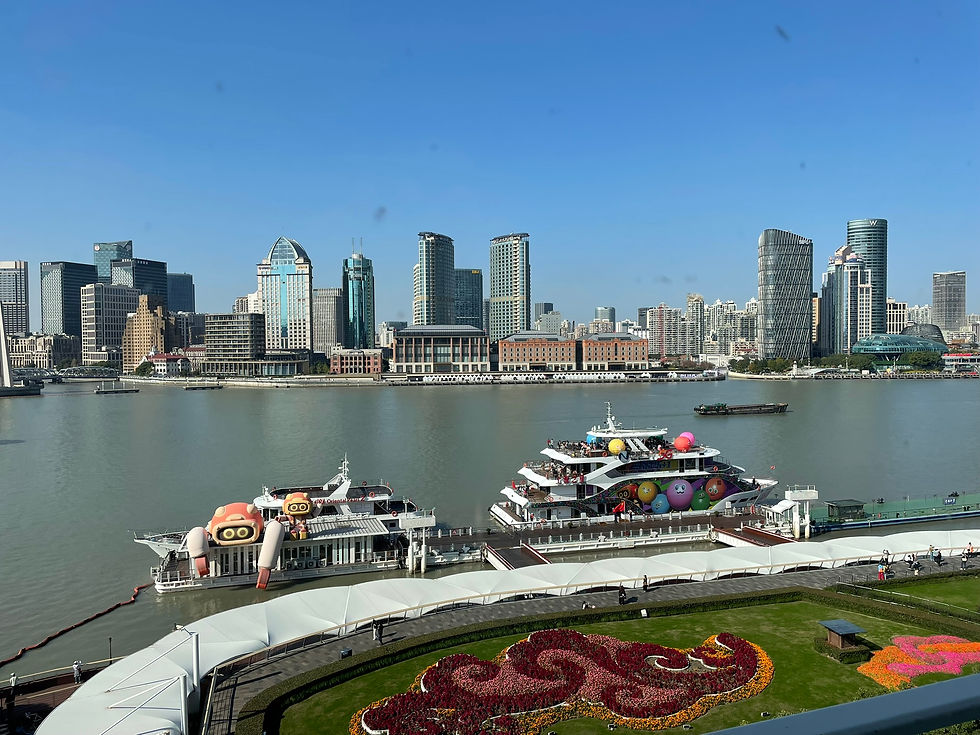
We have lunch at Resto and bar Roof 325 of the Shanghai Historical Museum (which we didn't visit) with a magnificent view of the Huangpu River with its many passing riverboats and barges. We look out over a jetty for pleasure boats and sightseeing boats. The menu is Western again: house-smoked salmon salad, truffle mushroom cream soup, Australian Wagyu steak with black pepper sauce. Just look at that…

In Pudong, we disembark beneath the Oriental Pearl TV Tower, where we enter a kind of elevated, wide walkway that wraps completely around a large circular intersection, offering ideal views of the city in all directions. Many people use escalators to access this, proving to be an excellent walking and photoshoot opportunity. Quite unique. And yet, there are quite a few people walking around. But what a unique idea! Ideal if you have ample urban space and can offer city walkers an alternative walkway attraction this way.

We still have a visit to the China Pavilion from the 2010 World Expo to look forward to. In the area, we'll pass several remaining structures from the Expo, including the UFO-shaped Mercedes-Benz Arena . The China Pavilion, on the other hand, boasts a unique architectural concept with its red lettering-like roof extension and the wide staircases leading up to it.
We have ample time to view a variety of modern art forms, including video art projected onto cylindrical walls, on various interconnected floors. Many truly beautiful works.
We still have time to kill, and on the way, not far from the airport, we stop at Florentia Village No. 4 , a beautifully designed outlet mall in pastel colors. Here you'll find virtually everything that defines luxury brands: French, Italian, and other fashion brands like Prada, Gucci, Cartier, and Louis Vuitton. The Chinese love expensive European brands; they're the ultimate status symbol. But this is an outlet mall? With these prices? No way.
At 7:00 PM, we're punctual and dutiful at the check-in desk, which doesn't open until 7:30 PM. After all the procedures, we arrive at the gate, hoping to find some food options, but it turns out to be just one place with only Chinese and snack food. Oh well, around midnight we board, landing home at 1:25 PM after what was, after all, a long night flight.
Some afterthoughts
About guides and pronunciation
The "R" is an issue with the Chinese. Tintin already taught us that the Chinese speak of "lock and loll" and "lollende loten" (lolling lots) . But that's not so bad. The average person on the street generally speaks zero English, not even in hospitality roles like on board ships or in top hotels. It's incomprehensible to us. Everyone uses a translation app. Even the airport information office. How did they do it back then?

And even. May (our Shanghai guide): "river" becomes "jivej ." The difference between thirteen and thirty is wafer-thin, in fact, throughout Asia. Moreover, guides never use structure in their explanations. Stories with arcs of tension, plots , building silence... zero. On the contrary, it's a continuous, relentless—when do they catch their breath?—stringing together lists full of names and dates unknown to us, exactly how they were apparently trained: not critical thinking, but memorization and reproduction, applied in all subjects of education. So be it. But all this can have painful consequences if, for example, fifteen and fifty are confused. The same with bread. Lin (Beijing guide): Do they make bread from wheat or from cannabis ? A difference, isn't it?
About food and weight
It turns out I'd gained a kilo and a half, despite taking at least an average of 3,000 more steps a day than I do at home. Those Chinese people can't be trusted; they even put something in the food besides electronics. Could it be?
The Knack Group
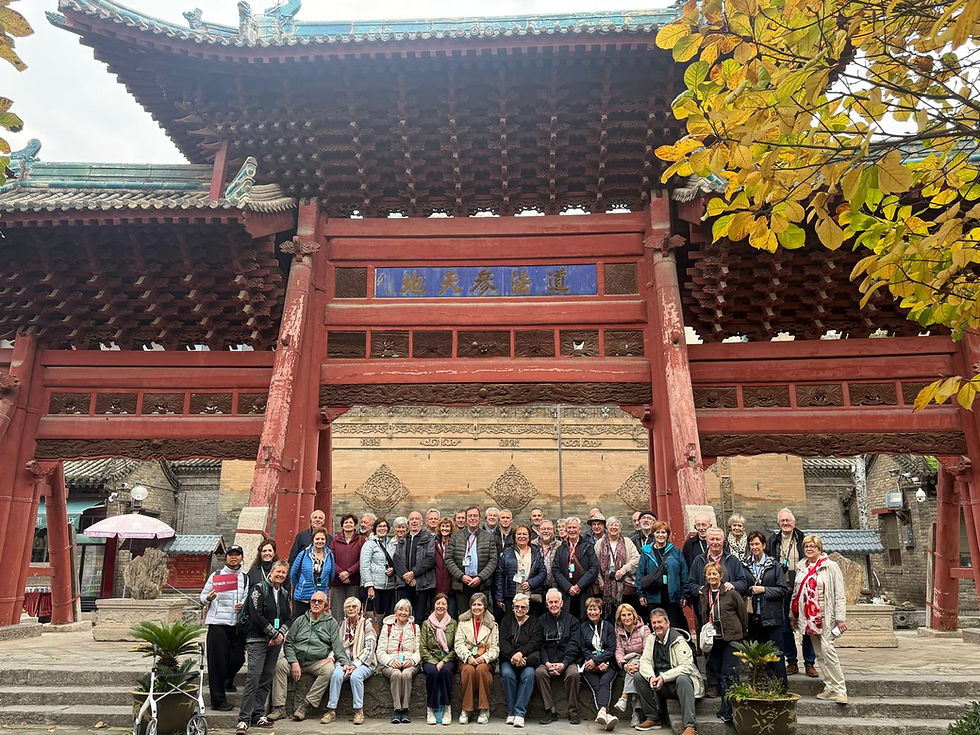
In my opinion, it consisted from start to finish of pleasant, classy, sympathetic, interested, and disciplined people. Everyone talked to everyone. In the jovial Johan, I found a humor soulmate with whom we had a pleasant banter and a good time exchanging witticisms and one-liners. With others, on the other hand, we had pleasant and interesting reflections. Wonderful, truly.

And then there's tour guide Karin , the ultimate mix of charming personality and know-how. I don't know a single person in this group with whom I didn't have a pleasant moment.
China, completely different, confronting, enchanting and in pleasant company?
Mission quite accomplished!
©WimVanBesien2025, this article is copyrighted and intellectual property protected.


Comments