
MAROONED, MOAI AND MUTINEERS
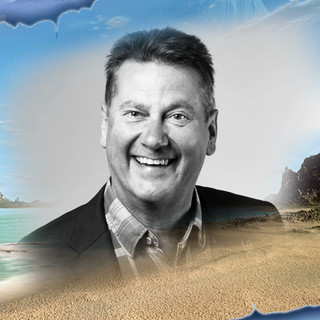
Expedition cruise Tahiti – Ana'a & Rangiroa (Tuamotus) – Pitcairn Islands/ Ducie – Rapa Nui (Easter Island) – Juan Fernandez Archipelago (Robinson Crusoe/ Santa Clara Island) - Santiago de Chile | October 14 – November 6, 2026
Preface
My life motto? To live life and, above all, to EXPERIENCE it. Well, there you have a lifeline right away: a sentence with the word 'life' in it four times!
I know. Who in God's name absolutely wants to go to the other side of the world (minus twelve hours)

time difference) to make an ocean crossing from Papeete (Tahiti) to Chile (San Antonio/Santiago)? Ten days at sea through the least visited parts of the ocean, across seven time zones ! And all that to visit the remote Pitcairn Islands (Mutiny on the Bounty!), the extraordinary Rapa Nui (Easter Island with its famous Moai statues), and Robinson Crusoe Island (a boyhood dream).
Who? Well, this Pipo, then! Childhood intrigues, adventure, and historic voyages: Columbus, Vasco da Gama, Magellan, James Cook, Captain Bligh… The globetrotter in me is awakening again after six months of three surgeries, a month and a half in the hospital, and months of immobility and a laborious recovery. I am desperately in need of DOING something! My passion for travel is rearing its head again. That old dream: Pitcairn, Easter Island, and Chile. The only problem is, those destinations are on the other side of the world, and such a trip is virtually unaffordable.
Until I am lucky enough to find perhaps the very last cabin with a Dutch cruise line, at an exceptionally low price. Admittedly, booked as a 'guaranteed', so without certainty regarding the cabin number.

Moreover, this journey will confront me with a world where nothing was ever self-evident or predictable, and where choices made could no longer be reversed. Confronting, challenging, and exciting. Totally my thing! No more backpack, but a comfortable expedition ship instead.
That emotion of traveling, of discovering… that feeling… please don’t take it away from me!
FYI: The actual travelogue is supplemented with sometimes more extensive, documented background information. These passages are always in italics . Readers in a hurry can skip them if they wish.
Papeete: a surprising start

Just like in February, another journey of more than 22 hours: from Charles de Gaulle via Los Angeles, with a two-hour layover and particularly thorough checks of our hand luggage. It is pitch black outside for twenty-two hours. A twelve-hour time difference. Finally, we land at 5:15, just at sunrise.
Upon arrival at the Kon Tiki Hotel, the surprise of our lives awaits us. The booked room turns out to be a so-called 'Polynesian Cabin': a dark, windowless cubicle measuring three by three meters, with two planks stacked on top of each other to serve as beds. A small ladder leads to the top one. Can you picture us doing that? Moreover, the toilets and showers are located in the hallway, shared. No idea how the cruise deal company could have done this to us!
Fortunately, for a surcharge, we can upgrade to a proper room. It is only available after check-out and cleaning, which means we have to kill another seven hours after those long, sleepless economy flights. The final room is basic, let's say three stars, but quite okay for us. Fortunately, the common hotel areas make up for a lot.

The breakfast room, bar, and entertainment room flow into one another. The bar is even built inside a vintage Volkswagen van. Cute and charming! A large mural illustrates the hotel's name: Kon-Tiki, referring to the famous raft expedition of the Norwegian Thor Heyerdahl. In 1947, he sailed from South America to Polynesia in one hundred days on a balsa wood raft, a yardarm, a distance of approximately 8,000 kilometers. A great story!
The absolute best, however, is the rooftop terrace, aptly named Reef Terrace . On the eighth floor, you enjoy a 360-degree panoramic view. Different music plays every evening and the cocktail menu is particularly extensive, although you have to shell out at least 19 euros for a drink. The pizza is excellent, but it is the nighttime view, with Moorea in the distance, that stays with you the most.

The panoramic restaurant one floor down also turns out to be a hit. Nella chooses a fresh red snapper , while I order a uniquely prepared tuna tartare. Tuna is, after all, the fish of the Pacific. My dish is prepared in a special way, including with fish roe.
The hotel is located opposite the ferry terminal building and barely five minutes from the cruise terminal, right in the center of Papeete. That probably also explains the availability of those cheap hotel cabins: many globetrotters and island hoppers travel here on a limited budget. You can read more about Papeete and French Polynesia in my previous blog: Paradise Exists .

Then the real adventure begins: aboard the Seabourn Pursuit , a relatively new expedition ship from 2023, 170 meters long and specially equipped for unique expedition cruises. Boarding goes super smoothly and we get a stateroom on the seventh deck midship portside . Perfect!
The sailing schedule
Below is the day-to-day itinerary from Papeete to San Antonio, Chile.
Because this is an expedition cruise to particularly remote areas, the times for the various nature and expedition stops are flexible. Everything depends on local weather conditions and the possibilities for safely going ashore.
Day-to-day sailing schedule (16 October – 4 November 2026)
Day | Date | Port / destination | Arrival | Departure |
1 | Fri. 16/10 | Papeete, Tahiti (French Polynesia) | Embarkation | 5:00 PM |
2 | Sat. 17/10 | Ana'a (French Polynesia) | 12:00 p.m. | 5:00 PM |
3 | Sun. 18/10 | Avatoru, Rangiroa (Fr-Polynesia) | 8:00 a.m. | 6:00 p.m. |
4 | Mon. 19/10 | At sea | — | — |
5 | Tue. 20/10 | At sea | — | — |
6 | Wed.21/10 | At sea | — | — |
7 | Thu. 22/10 | Adamstown (Pitcairn Islands, UK) | Expedition | — |
8 | Fri. 23/10 | Ducie Island (Pitcairn Islands) | Expedition | — |
9 | Sat. 24/10 | At sea | — | — |
10 | Sun. 25/10 | At sea | — | — |
11 | Mon.26/10 | Easter Island (Chile) | Full day | — |
12 | Tue. 27/10 | Easter Island (Chile) | — | Afternoon |
13 | Wed.28/10 | At sea | — | — |
14 | Thu. 29/10 | At sea | — | — |
15 | Fri. 30/10 | At sea | — | — |
16 | Sat. 31/10 | At sea | — | — |
17 | Sun. 1/11 | Juan Fernández Experience | Cruising | — |
18 | Mon. 2/11 | Juan Fernández Experience | Expedition | — |
19 | Tue. 3/11 | At sea | — | — |
20 | Wed. 4/11 | San Antonio (Santiago), Chile | Approx. 7:00 | Disembarkation |
Life on board: Expedition meets Hospitality
At remote destinations, we use Zodiacs, fast inflatable boats that allow us to go ashore and explore the surroundings with the expedition team.
The Pursuit carries 230 passengers and almost as many crew: a ratio of approximately one to one. Among them are 24 expedition team members. There are 24 Zodiacs on board, each suitable for sixteen people, including smaller Mark 5 boats for eight people, as well as a whole fleet of kayaks.

The expedition team consists of 24 specialists: physicists, biologists, ornithologists, anthropologists, historians, ecologists, marine biologists, geographers, and many more. Exploration meets hospitality.
The team members, led by Claudio Schulze (Mallorca) and Juan Carlos Restrepo (Colombia), look exactly as you would expect expedition experts to look: grey-khaki safari shirts, walkie-talkies, and sometimes megalomaniacal telephoto lenses. They engage in trekking, hiking, diving , and you name it. The men are mostly sturdy, bearded, hairy, muscular, and tanned guys. The picture is perfect!

Many passengers spend hours on deck to spot birds, dolphins, and other marine life.
As soon as someone discovers something, an almost ecstatic surge immediately erupts. Cameras click, species names are shouted, and everyone wants to see it.

Some fellow travelers are particularly sprightly, adventurous seniors, fully equipped with tropical clothing, neck scarves, sturdy trekking boots or water sandals, waterproof clothing, and survival backpacks.
It is incredible how even the somewhat stiffer individuals venture into a rocking Zodiac. An expedition cruise is clearly not for wimps!
I meet Captain Sasha Skladnoi from Ukraine. His father sailed for the Black Sea Shipping Company. Coincidence does not exist: I made my debut in the eighties as a Cruise Director on ships chartered by CTC Lines from that company. Well, look at that!
Ana'a: a first introduction to expedition life
Ana'a is an atoll in the Tuamotu archipelago: a small, flat island with few inhabitants, pure and unspoiled.

The Zodiac operations here are an experience in themselves. For every landing, we get extensive safety briefings, with an almost military list of all the do's and don'ts . You would think we were leaving on a military mission!
Once ashore, I walk to the other side of the island, where a beautiful, light blue lagoon sparkles.
In an open shed, I browse among handmade jewelry and ornaments crafted from the most diverse shells and stones. There is also woodcarving and other artisanal art.

A small orchestra provides the music. On the beach, four girls, adorned with flowers and colorful sarong skirts, perform typical Polynesian dances. Who doesn't know them: the swaying movements and hip-shaking steps, accompanied by guitars, ukuleles, conch shells , percussion, and lots of group singing.
There was already a snorkeling excursion in the morning, exclusively for experienced snorkelers due to the dangerous cliffs and currents. Experienced? I don't fall into that category. So I wisely decline.

Rangiroa: The Aquarium

The next day we reach Rangiroa , where I had been before in February. Back then, I went snorkeling in the famous zone called Aquarium . This time I opt for a glass-bottom boat , with a local guide who plays the ukulele and gives explanations in broken English.
Rangiroa is the largest coral atoll in the world, with a circumference of approximately 200 kilometers. The island is known for its black pearls and… wine. Yes, wine is produced on coral sand. I didn't taste it, though.
The Aquarium is teeming with tropical fish. We gaze in wonder. The boat driver even dives into the water as an extra attraction. He places bread under the glass, which all the fish immediately pounce on. A colorful spectacle of splashing fish species!

On the way back, our – well – guide weaves a hat and a small bag with a flower from coconut palm leaves. Unfortunately, we are not allowed to take these lovely creations on board.
Strict biosecurity rules apply in these areas. You are not allowed to bring foodstuffs, plants, animals, stones, or other natural materials on board, nor may you simply take anything ashore. All this is to protect the ecological balance and prevent invasive disturbances to nature.

Photos: Offshore Zodiac landings near the atolls of Ana'a and Rangiroa in the Tuamotu Archipelago. Blue
lagoons, hula girls, coconuts, snorkeling manta rays, sharks, triggerfish, and hundreds of other sea creatures and corals. And then back on board, where a dive into the infinity pool awaits. Poor me!
At sea: football on the Pacific Ocean
Just imagine. You're going on an expedition cruise, but you're also a football fan. And your team plays in the Champions League. Those are matches you don't want to miss!
In the middle of a distant ocean, however, that is not a given. I armed myself with an HDMI cable, VPN, and all the accompanying equipment, but initially, it didn't work. Thanks to the helpdesk and a paid upgrade to the free Wi-Fi package, which increases the network capacity sufficiently to stream live video, it eventually worked out.
We can watch the match on the big screen in the meeting room. And Club Brugge even beat Lens 3-0! It doesn't get any better than that. Even in the Pacific, football remains sacred.
We also get to know Rolf and Geerde, two energetic, always cheerful Belgians who have already been on board for two months. They enjoy life and their cruise so intensely that it almost seems sinful.
Pitcairn: where the mutineers sought refuge
After three days at sea and crossing two time zones, losing an hour each time, we reach the Pitcairn Islands . Talk about remote: this is a massive one. Fewer than fifty people live on the island.

They are the umpteenth generation of descendants of Christian Fletcher , the mutineer of the HMS Bounty . He set Captain William Bligh and eighteen loyal men adrift in a longboat, after which he fled to this island with eight companions, a dozen Tahitian women, and eight men.
There, he set the ship on fire to prevent it from being discovered. The plan was a carefree and happy life on a remote island. Unfortunately, things turned out differently. Internal tensions, conflicts, and settling of scores followed one another.

In the end, only one man, John Adams , remained with a few women and children when the island was rediscovered. True story!
The descendants therefore live in extreme isolation, approximately 4,500 nautical miles from Los Angeles in the northwest and the same distance from New Zealand in the southwest. Despite the small population, there is no inbreeding, thanks to the original genetic diversity resulting from the mixing of European (the mutineers) and Polynesian blood. Curious. In 2004, however, the island did make negative headlines due to a case of sexual abuse of minors.

The weather is unpredictable, even though it is a tropical island. Today it is barely 20 degrees, with a light breeze. A few days ago, it was hit by the strongest cyclone in thirty years, with wind speeds of up to 82 knots, or about 150 km/h. The damage is clearly visible: everywhere I see broken palm trees and other damaged vegetation.

The biggest challenge, however, is getting ashore at all. Conditions are uncertain, and once again we receive an extensive briefing on the safety measures. The landing with the Zodiacs is quite a creepy adventure.
The ocean swell causes waves with height differences of up to one and a half meters.

When transferring from the ship, four crew members hold you firmly with the so-called sailor's grip : arm in arm, so that you do not get caught between the ship and the Zodiac. A fifth man determines the right moment and gives the signal with one short command: "Now!" Then you must transfer in one movement. At the small mooring pontoon, the scenario repeats itself. The Zodiac must maneuver precisely between the rolling waves to dock safely. Timing is everything. A spectacular display of teamwork, but for many passengers, it is still a nerve-wracking moment!
The climb to Adamstown , the only village, is particularly steep and tough. After my recent surgeries, I doubt if I can handle it yet. Fortunately, I can go up by quad for ten dollars. I will, however, do the descent on foot.

Adamstown turns out to be just a handful of small buildings: a few hangars, an unsightly little church, a small post office and a small school. At this moment, there aren't even any children on the island. Fortunately, there is also the Bounty Museum . I have my picture taken by the original anchor of the Bounty and then immerse myself in the replicas, photos, and historical artifacts that illustrate the fascinating story of Mutiny on the Bounty .
The story received three film adaptations. The films starring Marlon Brando (1962) and Anthony Hopkins and Mel Gibson (1984) have become classics, in particular.

The islanders must live off what their small island produces itself. A supply ship visits only a few times a year. Their diet consists mainly of fish, local vegetables, and fruit. In addition, limited expedition tourism, special stamps, and local honey provide some income.
Survival, history, and exceptional cultural heritage define the unique significance of this island. The ordinary islanders are particularly friendly, in stark contrast to the place's dramatic past.

I see the layers of lava on the mountain flanks and the rugged, pristine surroundings. Everything exudes isolation. It feels like a voyage of discovery into a world that seems hardly changed. The entire operation, from the crossing to the visit itself, is one big adventure. I think it is fantastic!
Initially it is still raining, but later the sun breaks through and it becomes particularly pleasant. It is incredible how many fellow travelers undertake a seven-kilometer trek to the highest point of the island via a steep and muddy path. Reportedly, the view over the pristine landscape is more than worth the effort.

The next day we arrive at Ducie Island , one of the four Pitcairn Islands. It is an uninhabited atoll. We do not dock; we sail along the coast in the Zodiacs. For the many bird lovers on board, that is the ultimate experience.
You can clearly tell we are on an expedition cruise. As soon as someone spots a dolphin or whale, everyone rushes to the railing to photograph the animal. Some use telephoto lenses with which you could presumably also study the moon.

It really is a different audience than on a regular cruise. The lectures and explanations on board are exceptionally well presented and well-attended. I am learning all sorts of things about volcanoes, weather conditions, marine life, birds, anthropology, and much more. The specialists back up their explanations scientifically, but at the same time present them in a fascinating and entertaining way. High-level infotainment!
Back on board, I have a Michelada : a kind of Bloody Mary, but with beer instead of vodka. This is followed by a Mexican buffet with enchiladas, tacos, chili con carne, fajitas, quesadillas, red bean paste, spicy sauces, and a spicy bean soup. Totally my thing!
During the daily recap , the atmosphere is electric: we did it! We made it! The assistant sailors who helped with the landing, along with everyone involved, are showered with praise. There is actually a slight sense of victory euphoria. And rightly so!
Sea Days: entertainment and unexpected talents
Three more days at sea follow. In addition to the lectures, all kinds of fun activities are organized. Take Team Trivia , for instance. Nine teams of ten participants compete for victory every day at sea. I am part of The Smartinis .
At the start, all participants must raise their hands and solemnly repeat: "Team Trivia is only a game and James is always right!" James Templeton from Liverpool, our Cruise Director, hosts the quiz. The trophy for the worst-performing team is a slovenly doll, Jane , who is decorated differently every day and gets her own absurd story each time.

The teddy bear toss is also a simple idea, but particularly fun. From the ninth deck, you have to try to land a teddy bear in a champagne bucket on the fourth floor at the top of the central staircase. Quite a challenge! It results in sensational misses everywhere.
I mainly want to try it for our little Sofia. And sure enough, it works! I win the stuffed animal. A few days later, the trick is repeated with polar bears. This time without success for us.
Another top activity is the Fun Fair : an hour of deck games , organized by the

various departments on board.
The expedition team has us throw lifelines at buoys. At the bar staff, we try to aim ping-pong balls into a whole series of glasses. The kitchen brigade has us taste and identify eight different herbs. At Guest Services, we have to match the right faces to the right job descriptions. The navigation department tests our knowledge of the flags of the world. There, Nella and I achieve a victory, good for two penguin dolls and two caps!
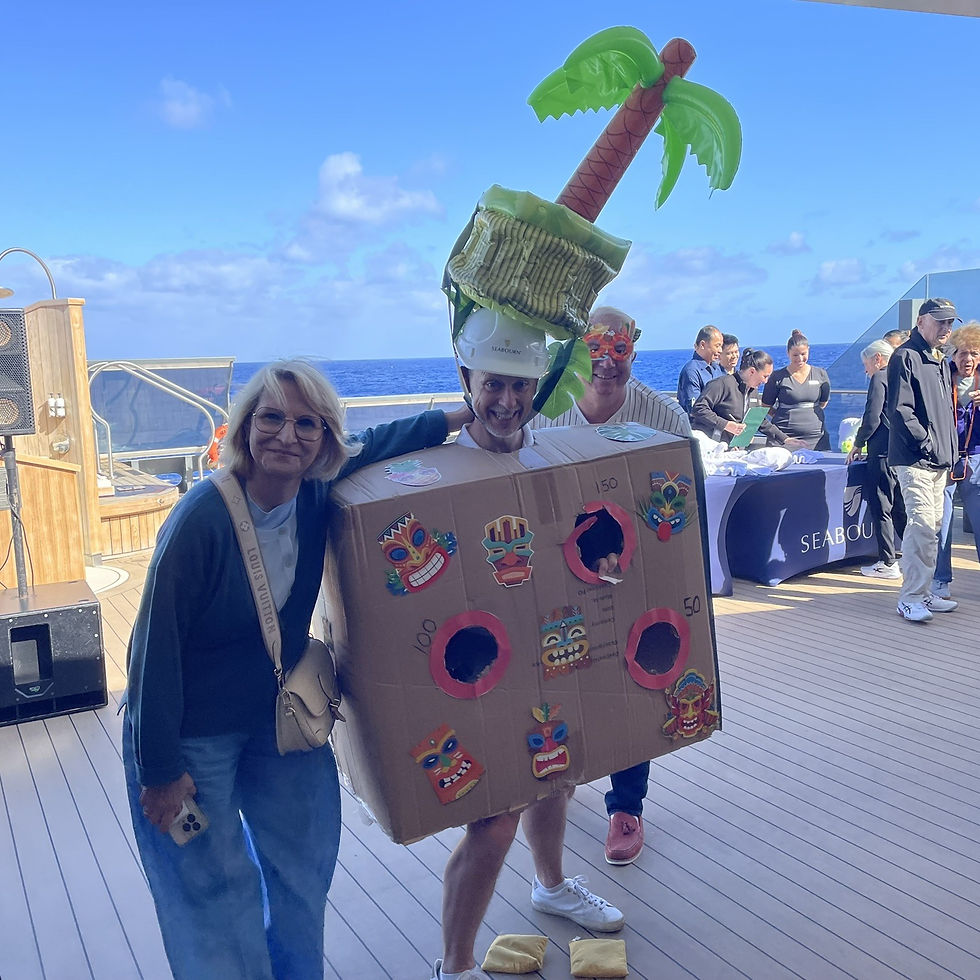
Housekeeping is also present. They demonstrate how to create all sorts of fun shapes and animals with towels, after which we get to try it ourselves. Finally, we get to throw rags at the Cruise Director, who has dressed up as a crazy box with holes that can be used to earn points. The plastic palm tree on his head, which we are aiming for, is naturally the most fun target.
On Halloween night, a themed dance party is organized. The Expedition Lounge transforms into a disco, and the three musicians form a real party band. People dance like there is no tomorrow. I have rarely seen a cruise party go so wild!
Always fun. The challenge is to build a boat by the end of the trip using materials found on board. It must also be seaworthy enough to cross the swimming pool without capsizing. The captain and a few officers form the jury. Among the results are some fabulous, special, and even beautiful creations, and not a single one of the five entries intends to tip over while sailing. Fun!

The look-alikes on board are also remarkable to me. An American passenger looks exactly like actor John Goodman, the Indian nurse reminds me of Jinnih Beels, and waiter Timashe from Zimbabwe is a super-friendly, always cheerful clone of Lukaku. Carol (South Africa), the Food Operations Manager , on the other hand, bears a resemblance to Jane Birkin.
Because the ship previously called at Australia, a special IPA is available alongside the usual Stella, Beck's, Peroni, Corona, and Budweiser, together with Cascade Beer from Tasmania and Victoria Beer from Australia. All quite palatable!
Rapa Nui: the mystery of the Moai
Rapa Nui , better known as Easter Island .

"Iorana!" (Hello!) A visit to Easter Island will not be a walk in the park . The island has no harbor facilities and the coast consists largely of rocks. Beforehand, we receive briefings on the meteorological conditions, currents, and especially the swell : the height and strength of the waves.
Everything is constantly being reassessed in terms of safety. The expedition operation on Easter Island is particularly delicate, and weather conditions are unpredictable and changeable.
My plan is clear. On the first day, I mainly want to see what the island is world-famous for: those fantastic, enigmatic statues, the Moai . How and why were they erected? How were they transported? What was their precise meaning? A remarkable history, still full of mysteries.
In the afternoon, I want to go to Hanga Roa , the only town on the island, actually more of a village. About 95% of the population lives there. The island has about 8,600 inhabitants, of whom about 60% are of indigenous descent. Our guide Martin says: " Finding a suitable partner who matches is very difficult, and we all know each other! "

The inhabitants are naturally heavily dependent on imports. A cargo ship passes by three times a month. The religion is predominantly Catholic, but with many influences from the spiritual world. Everyone speaks Polynesian, Spanish (the island belongs to Chile), and English. Rapa Nui has its own time zone, is a maximum of thirty kilometers wide, and has a triangular shape with four volcanoes.
On the second day, an excursion to ancient cultural and archaeological sites is on the program, with a wealth of curious stories and legends, including that of the Birdman (see further).
The history of Easter Island in four periods
1. Polynesian colonization (ca. 400–1200 AD)
Seafaring Polynesians discovered and populated the remote island. They arrived in what was then a fertile, green landscape and called it 'The Navel of the World'.
2. The Time of the Moai (c. 1100–1650 AD)

The population built nearly a thousand iconic stone statues, the Moai, on stone platforms called ahu. Due to deforestation, including for boat building, and a rat plague, the island's natural resources became depleted.
3. European Discovery and Decline (1722–19th Century)
On Easter Sunday, April 5, 1722, the Dutch explorer Jacob Roggeveen discovered the island as the first European. This was followed by famines, civil wars, Peruvian slave raids in the 1860s, and smallpox epidemics. By 1877, barely 110 original inhabitants remained. Incredible, isn't it?
4. Chilean Annexation and the Present (1888–present)
The island has been on the UNESCO World Heritage List since 1995. Today, the local economy relies primarily on cultural tourism and the preservation of Rapa Nui culture.
An alternative landing: the sea decides
The evening before our arrival, during the daily recap, it is announced that the planned landing is impossible due to the heavy swell. The waves here could reach up to three meters high. After the previous experience with the one-and-a-half-meter waves at Pitcairn, it is clear that this is not feasible.
Therefore, we are heading to the better-sheltered north of the island: Anakena , where the only real beach is located. There, we can moor at a narrow jetty with a nose-like structure (frontal mooring).
The entire program needs to be rearranged. Hanga Roa is now eighteen kilometers away, a drive of about 25 minutes. A shuttle service will be provided.

An additional complication is the presence of the MS Silver Cloud . Two ships, one small berth. That ship is lying about a mile and a half away because it has to drop anchor. The Pursuit, on the other hand, features modern, more efficient electric motors and an advanced Dynamic Positioning System (DPS).
This system acts as a kind of virtual anchor. Using GPS and data on current, swell, and wind, the computer automatically keeps the ship in position by continuously adjusting the engines.

The Zodiac rocks, slides against the ship or the pontoon, and the crossing involves a considerable amount of splashing water. Not an outing for those afraid of wet feet!
Moreover, disembarking takes some time. The large Zodiac versions can accommodate fourteen passengers and two crew members each. I make sure I am in the first boat. In the distance, I can already see the first Moai among the palm trees.
Once ashore, life jackets are removed and a strict inspection follows. As on all Polynesian islands, strict rules apply to bringing in fruit and food, to protect local ecosystems. The no-litter policy is also taken particularly seriously: leave no waste anywhere.
The Moai Quarry
We board small vans that first take us to Vaihu , our first stop in the National Park. Here, we discover how the original inhabitants lived in peculiar structures. They are actually caves or huts with only one small entrance. Inside, it is completely dark.

We also learn how important the rock gardens were. They protected the plants from the sometimes particularly strong winds and, at the same time, helped to collect rainwater optimally.
This island is all about rocks and stones. That soon becomes clear. The landscape is quite barren, with flat hills. Along the way, however, we see horses and cows that sometimes simply walk freely across the roads. Here and there are some woods, with a striking amount of dead wood. I see more clover than grass.
Afterwards, we drive to The Factory , the quarry where the Moai were carved. What follows

a bumpy walk over the slopes of the extinct volcano Rano Raraku .
Statues are scattered all over the hill: fallen, damaged, or re-righted. 397 in total. Some have been excavated, others are still two-thirds in the ground.
What a fascinating place to photograph. Those curious statues capture the imagination from every angle.
The secret of the 'walking' Moai

For a long time, Western scientists believed that the statues were rolled to their destination lying on tree trunks. However, the oral tradition of the Rapa Nui themselves held that the statues 'walked' to their final destination.
Recent three-dimensional biomechanical research shows that the islanders may have been right. The Moai were deliberately carved with a D-shaped base and a forward-facing center of gravity.

With the help of sturdy ropes and three teams – left, right, and back – the islanders made the statue wobble in a controlled manner. By tilting it alternately to the left and right, the leaden statue 'walked' forward step by step. A bit like moving a heavy refrigerator.
Only when a Moai reached its final ceremonial ahu was the back of the base chiseled to allow the statue to stand upright stably. The coral eyes were also added at this time. In doing so, the statue was, as it were, 'activated'.
The original Rapa Nui culture
The classical culture of the island was complex and deeply spiritual. The Moai were not gods, but portraits of deceased chieftains. It was believed that the statues absorbed the supernatural power, the mana, of the ancestors to protect the community. That is why almost all Moai face with their backs to the sea: they watch over the villages.

Society was divided into rival families or clans, led by a religious and political leader, the ariki.
Moreover, Easter Island is one of the few places in the world where its own script was independently developed: the RongoRongo script. It has never been deciphered. The few islanders who could read it were taken away by slave traders in the 19th century or died of disease.

At the end of the walk, we see Tongariki in the distance, the platform on which fifteen relatively intact Moai stand centrally in front of a bay. This is undoubtedly one of the most spectacular views of the island. And the most iconic.
Once there, you keep taking photos from every possible angle. It is so special and exceptional, both because of the images themselves and the impressive surroundings.

Afterwards, we return to the golden-yellow beach of our landing site. At Nau Nau , four more Moai stand on a beautiful platform, complete with headdresses. The surroundings are stunning, with light dune sand and palm trees. There are a few small restaurants, and the sea invites you for a refreshing dip. Although… the water here is bitterly cold!
We return late, but at 6 p.m. a local is already standing at the Discovery Center.
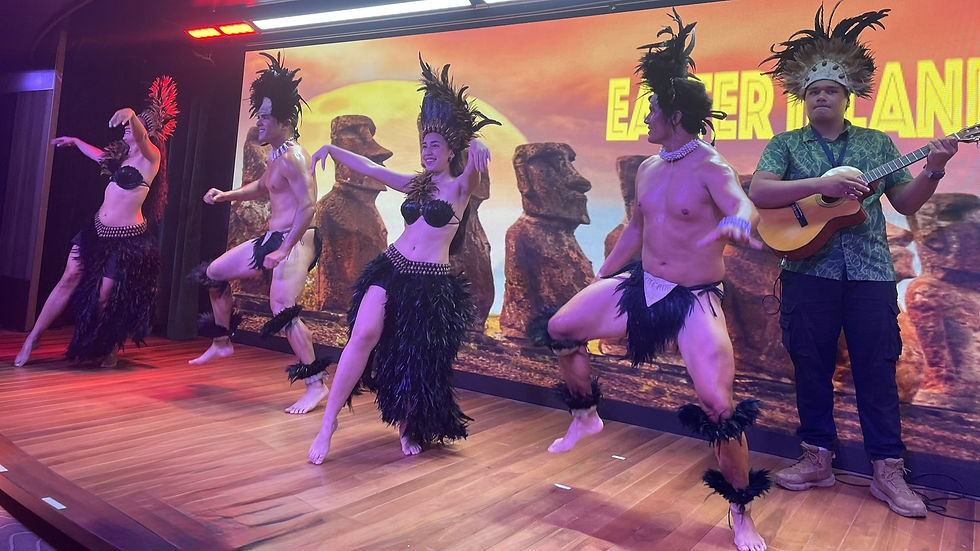
A folklore performance is planned. That center is somewhat of a theater on board, where, incidentally, more lectures than entertainment take place.
A guitarist, a ukulele player, and a percussionist provide the music. Three ladies wear straw skirts, moving their

hips and showing off a feathered headdress.
Two gleaming, muscular, and nearly naked men wear nothing but a loincloth. They look quite dangerous, let out cries, and make wild gestures to the folk music. All the performers sing along continuously.
Easter Island day two: Along the coast and to Orongo
For the second day, I make sure to be among the first Zodiac passengers again. It is a beautiful, sunny day of 21 degrees. The sun rose spectacularly at 7:30, although there is a light, fresh breeze.
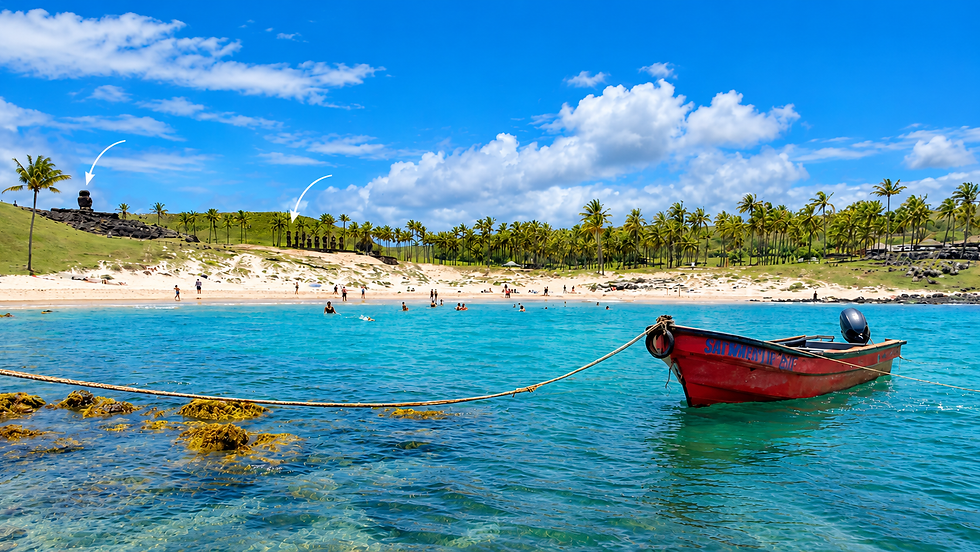
Once ashore, we are informed that the shuttle service to Hanga Roa is being suspended for the time being. Despite the fine weather, weather services are predicting increasingly rough seas. Therefore, all excursions should end at the landing site around one o'clock. Only then will it be decided whether the ship can maintain its original departure time of 17:00 and if shuttles to Hanga Roa will continue to run.
Optional, paid activities, such as a volcano trek or an overnight stay on the island, can also be shortened.
We are first heading to a beautiful location on the east side of the island. Against the

Against a backdrop of a stormy sea, a row of Moai stands neatly on their platforms. A little further away, another one stands apart, and another: the only Moai on the island with eyes, which were apparently added later.
Once again, a perfect opportunity to take photos. The foaming waves of the ocean form a spectacular backdrop for these unfathomably sleek, actually extremely simple but intriguing images, with their strikingly pronounced noses.
Afterwards, we drive along the impressive coastline, dotted with stone or wooden statues, through Hanga Roa and on to the southern tip of the island. The large volcano Rano Kau is located there.

From the rim of the volcano, we can admire the enormous caldera or crater, about one and a half kilometers wide. The volcano has been extinct for about twenty centuries. There is now a lake in the crater, with floating moss that, according to one explanation, can be processed into a type of clothing fabric. The water currently forms a kind of drinking water reservoir nine meters deep.
Next, it goes to Orongo , an archaeological site on the flank of the volcano.

Here stand 52 simple shelters, built of rocks and largely above ground. To get inside, you have to crawl in through one side. They actually look like small caves. Their important feasts and ceremonies used to take place here.
The Birdman Cult: a life-threatening match
The Birdman cult, or Tangata Manu, was an ancient religious and political ritual on Rapa Nui. It gradually replaced the earlier ancestor worship, in which the famous Moai statues played a central role.
How did it work?
In the 17th and 18th centuries, ecological problems and internecine wars weakened the traditional leaders. As a result, a warrior class, the Matatoa, came to power.

Every spring, upon the return of the migratory Manutara (the sooty tern), important tribal chiefs selected young men of lower social rank, the so-called hopu manu, for a life-threatening contest.
From the ceremonial village of Orongo, the participants had to climb down the steep, 300-meter-high cliffs of the Rano Kau volcano. Next, they swam through turbulent, shark-infested waters to the small rocky islet of Motu Nui.
There they waited until the first bird egg of the season was laid. Whoever was the first to secure an intact egg tied it to his forehead, swam back, and climbed the steep rock faces again.

He handed the egg to his tribal representative, who subsequently received the sacred title Tangata Manu, the Birdman, for one year. That title brought considerable political power and special privileges for his clan.
The memory of this special tradition lives on in hundreds of rock drawings, the so-called petroglyphs, around the ceremonial village of Orongo. The remarkable ritual was later abolished by missionaries.
It was a particularly important ceremony for the residents. Protection against the wind turns out to be essential here, by the way. It is damn cold and very windy. My KW is flapping!

Afterwards, we drive to Hanga Roa , where we visit a typical central market full of artisanal objects. It is strongly emphasized that all imitations of the stone Moai figurines, wooden statues, beads, and necklaces are actually made on the island itself. So, no Made in China !
I sample a locally brewed beer, Mahina , from a delicious, colorful can. Hanga Roa has a number of cozy restaurants and bars, some even built over the surf. The village exudes a relaxed atmosphere while still offering the necessary visitor facilities. Especially in January and February, the summer months, it gets a bit busier and warmer here.

Plant growth is quite limited and the climate is subtropical. The palm trees appear to have been imported from Tahiti, just like the eucalyptus trees from Australia.
In Hanga Roa, we eventually get an extra 45 minutes and the good news that the original timing is being stuck to after all.
During the return trip on the Zodiac, we are joined by two new entertainers who were flown in especially: a singer and the Brazilian guitar virtuoso Diego Figueiredo , who was nominated for a music award. They also have to help load their luggage but immediately receive a wet welcome baptism!
At 5:00 PM, a Bossa Nova Sail-Away Party begins on deck five by the pool, naturally with the necessary cocktails. This is followed by another recap , which is celebrated like a victory. Thanks to all the sailors and the captain for ensuring the success of two particularly enjoyable days on this remarkable island.
The Juan Fernández Archipelago: Robinson Crusoe becomes reality
Now follow four days at sea, a distance of approximately 1,650 nautical miles, and another time change.
Next, we reach the Juan Fernández Archipelago, 674 kilometers from South America. The area is currently a UNESCO biosphere reserve.

The archipelago consists of three islands. One of them is Selkirk Island , named after Alexander Selkirk , a Scottish outlaw who washed ashore there in 1704 and lived in complete solitude for four years and four months. His story inspired Daniel Defoe to write Robinson Crusoe , although Defoe relocated the story to the Caribbean.
Santa Clara: fur seals and birds

We first dock at Santa Clara Island , barely one kilometer long. It is uninhabited and geologically particularly fascinating. The island has hills, hardly any vegetation, and rocky flanks with, as it were, thick veins.

We see quite a few playful fur seals, birds, and even a stray albatross. Going ashore is not possible, but Zodiac cruises are organized along the coast. Ideal for taking photos of the seals and birds.
As we set sail, a delightful caviar party follows on the deck. The hotel manager, the chef, and the bar staff spoil us lavishly with caviar bites, champagne, and various cocktails. The musicians provide dance music by ABBA and the Bee Gees. One has to let oneself be pampered every now and then!
Robinson Crusoe Island: a boy's dream

A few hours later, we reach Robinson Crusoe Island , once a hideout for pirates.
We position ourselves in Cumberland Bay , near the village of San Juan Bautista . The next day the sea is much calmer and I head out immediately. I almost have a Zodiac to myself!
Once landed in the small harbor, I take a brisk walk to the far end of the bay, through a park and past a cemetery. There I discover a platform with a hole in the hill in which a cannonball is still lodged. It was fired by the German ship Dresden during the First World War.
That ship lies here a few hundred meters away, sunk in the bay after a lost

battle against the British back then. A white buoy marks the spot.
It is a charming island, once again with few inhabitants: between 800 and 1,000. The local population lives mainly from lobster fishing, destined for export to China, and from small-scale ecotourism.
I pass an inconspicuous little post office and then make a strenuous climb to see the famous hummingbirds : hummingbirds that suck nectar from Chinese lantern flowers with their long beaks.
A fascinating spectacle! They are teeming with them. The males are orange, while the females look completely different, with a silver-blue color. They are endangered animals, just like three species of petrels and the fur seals.
The views here are phenomenal. After the descent, I discover on a modest little terrace that even this small island brews its own beer: an amber and a stout. Cerveza Archipiélago .

In the afternoon, a Pirate Party takes place on land. Costumed islanders generously serve us pisco sours (Chilean brandy with lime juice, sugar syrup, egg white, and bitters), appetizers, gyoza, pieces of octopus, and grilled fish skewers. A band plays upbeat music that clearly already sounds somewhat South American. There is plenty of chatting, eating, and enjoying oneself.
Upon departure, an elaborate Sail-Away Party will follow on the open deck. With plenty of champagne, caviar appetizers – served by the captain himself – salmon, tartare bites, and of course cocktails and dance music.
Upon my return, I saw a fishing boat bringing large barrels full of spiny lobsters on board. It concerns a type of lobster, caught in an environmentally responsible manner using strategically placed traps.
And sure enough, in the evening we can choose between paella with lobster in the Colonnade or a simple preparation in the restaurant. The seafood turns out to be substantial, tasty guys!

San Antonio and Santiago de Chile: the end of a special journey
After just one more day at sea, we reach the port of San Antonio . Disembarkation proceeds exceptionally smoothly. Not a single passenger is sailing on. Some have been on board for more than two months, from Broome in Australia.
For, remarkably enough, the ship is going into dry dock for eight days, even though it is barely three years old. Carpets need to be replaced, doors repaired, and everything must be prepared for the next season: Antarctica, the Chilean fjords, the Falklands, South Georgia, and even more harsh, barren natural destinations. These turn out to be particularly popular. After all, the Pursuit was built specifically for this type of expedition.
The transoceanic journey of the Seabourn Pursuit From Tahiti to Chile covered roughly 4,500 nautical miles, about 6,500 kilometers.

We arranged a taxi to take us to Santiago, where the airport is located. Since we may never return here, I booked an extra day to explore the city. When our driver asks the classic question: " Where are you from?" the equally predictable answer follows: " Loekaakoe! De Brown! " Football is clearly a universal language here too.
The drive takes about an hour and forty minutes. We drive through a slightly hilly, green landscape, until the Andes appear in the distance, with their snow-capped peaks.
We drive into Santiago de Chile , a modern urban area with more than five million inhabitants, wide avenues, heavy traffic, and considerable hustle and bustle. Upon arrival at Le Méridien , we immediately hop on a sightseeing bus to quickly explore the city.

There aren't many old colonial and historic buildings. There are, however, high-rises, large shopping centers, and grill restaurants. There are a few impressive squares, such as the Plaza de la Constitución , with the Palacio de La Moneda and the government buildings. They still remind me of Pinochet 's coup against Salvador Allende in 1973.
Actually, it is mainly the Plaza de Armas , with the Metropolitan Cathedral , the National Historic Museum , and the Post Office , that still shows some historical architecture.
The Santa Lucía hill, with its park, terraces, stairs, fountains, and viewpoints, together with the richly fountained Plaza de la Aviación along the brown Mapocho River, reveals a greener side of the city. There are also quite a few traditional wineries, such as Santa Carolina Vineyard , founded in 1875, which produce excellent Chilean wines. Unfortunately, we lack the time for a visit.

And then there is the Costanera Center , the tallest building in South America, with an observation platform at the top that offers a 360-degree view.
Fortunately, there is the iconic top attraction: the cable car . Two cable car lines, with two intermediate stations, and a rack railway from 1925 take visitors to the top of the hill Cerro San Cristóbal . There, you get a stunning view of this enormous city and the impressive peaks of the Andes. An absolute must-do!
The entire hill is part of the Parque Metropolitano , the largest urban park in Latin America. There you will find, among other things, a zoo, various natural and ecological attractions, botanical gardens, two swimming pools, cafes, and a fourteen-meter-high statue of the Virgin Mary. Everything is connected by winding, beautifully landscaped walking paths.
Once back, I’ll treat myself to a real ceviche… Or wait, did you think?
Back home
The next morning, a thirteen-and-a-half-hour flight to Paris awaits us. We land around five o'clock in the morning, at a time when it looks as if a hundred planes have arrived at once. There are incredibly long queues at immigration. I have never seen such queues ! Eventually, we are back home around 10:30.
Post-mortem
What a journey! From the Polynesian lagoons and the mysterious Moai to the history of the mutineers on Pitcairn, the pristine Juan Fernández Islands, and Robinson Crusoe's boyhood dream.

Thousands of kilometers of ocean, sailing for days, unexpected adventures, special encounters, history that suddenly becomes tangible, and above all, destinations you cannot simply visit.
An expedition cruise is clearly something different from a regular cruise. Sometimes you have to fight the waves to reach land, and sometimes nature decides that you cannot go ashore at all. But that is precisely what makes it so special.
And after my miserable months leading up to it, it felt extra good to have been on a journey of discovery again. Marooned, Moai, and Mutineers. A trip to EXPERIENCE!


Comments